


Global Yogurt Packaging Guide
IML Trends in the Global Yogurt Market
Yogurt brands are asking packaging to do more: protect a refrigerated product, communicate nutrition and flavor quickly, survive cold-chain handling, and support clearer sustainability goals. In-mold labeling (IML) brings the decoration and plastic container together during molding, giving dairy producers a durable, high-impact format for both single-serve cups and larger family-size tubs.

Quick Answer
The worldwide yogurt market is moving toward more varied products, stronger shelf communication, convenient formats, and packaging designed with recycling in mind. IML polypropylene cups and tubs can support these needs through full-surface graphics, moisture-resistant decoration, repeatable molding, and a label that becomes part of the container. However, the best package is not chosen by appearance alone. Cup geometry, lid fit, sealing-film compatibility, food-contact documentation, cold-chain testing, and local recycling systems all matter.
Contents
What Is IML in Yogurt Packaging?
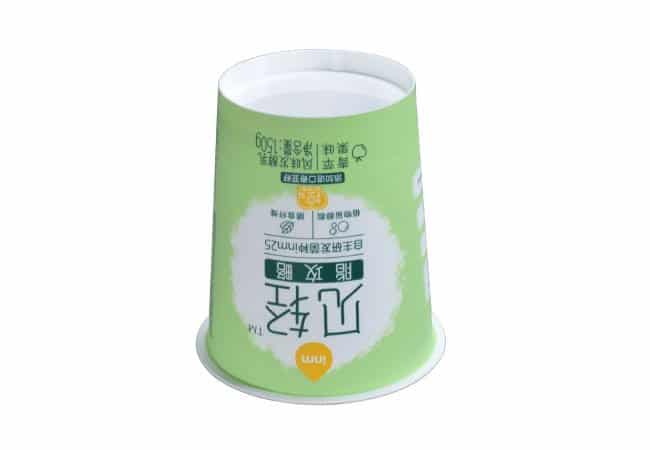
IML stands for in-mold labeling. As described in the original article, a preprinted label is placed inside the mold before the yogurt container is formed. During injection molding, the label bonds with the plastic and becomes an integrated part of the finished cup or tub. For polypropylene packaging, the label is commonly selected to work with the PP container structure, helping the decoration remain attached through filling, refrigeration, transportation, and retail display.
This differs from a pressure-sensitive label or a paper sleeve applied after the container has been molded. Those methods can still be suitable for certain programs, especially small launches or frequently changing designs. IML becomes especially attractive when a yogurt producer needs durable graphics, broad decoration coverage, repeatable high-volume output, and a premium appearance without adding a separate post-molding labeling step.
Packaging is the final physical interface between the yogurt and the shopper. It must hold an acidic, refrigerated food while displaying flavor, nutrition, brand identity, storage instructions, and regulatory information. That combination explains why more dairy producers evaluate IML cups when upgrading a yogurt range. For a closer look at the process itself, see Honokage’s introduction to in-mold labeling.
| Packaging Decision | Needs, IML Support and Buyer Checks |
|---|---|
| Shelf communication | Brand need: Clear flavor, protein, ingredient, and brand cues. How IML helps: High-resolution graphics across a broad printable area. Verify: Artwork distortion, barcode readability, label position, and color tolerance. |
| Cold-chain durability | Brand need: Decoration that stays neat under moisture and handling. How IML helps: The label is fused into the molded package. Verify: Refrigeration, condensation, scuff, drop, and stacking performance. |
| Production efficiency | Brand need: Consistent output at commercial volume. How IML helps: Molding and decoration occur in one controlled process. Verify: Cycle time, cavity consistency, scrap rate, and label placement. |
| End-of-life design | Brand need: A simpler material story and clearer sorting. How IML helps: A PP cup with a compatible PP-based label can support a mono-material approach. Verify: Local collection, sorting and recyclability guidance, including inks and additives. |
Global Yogurt Trends Shaping IML Packaging
Trend 1
Protein, probiotics, and functional positioning need faster shelf communication
Yogurt has expanded beyond a simple breakfast product. Greek-style, high-protein, probiotic, low-sugar, children’s, lactose-free, and plant-based alternatives compete in the same refrigerated area. That makes package communication more demanding. Shoppers should be able to distinguish the product type, flavor, serving format, and primary benefit within seconds.
IML gives designers a large printable surface that can organize these messages without relying on a small front label. The front panel can lead with brand and variety, while side and back areas carry ingredients, nutrition, multilingual copy, preparation ideas, and disposal guidance. USDA data also show that yogurt has grown as a component of U.S. dairy consumption over the long term, supporting continued packaging innovation even though individual markets and product segments develop at different rates.
Trend 2
Single-serve convenience and family-size value are growing side by side
The market does not move toward one universal cup size. Single portions serve lunchboxes, convenience channels, sampling, and calorie-controlled products. Larger tubs suit family use, foodservice, value packs, and products that are opened more than once. Each format creates a different engineering brief.
A small cup needs efficient nesting, high-speed denesting, controlled wall thickness, and dependable foil sealing. A large tub needs stronger sidewalls, better top-load performance, an ergonomic opening, and a secure overcap for repeated use. Brands should therefore select capacity only after reviewing filling equipment, distribution case dimensions, serving behavior, and target price. Honokage’s guide to choosing yogurt container capacity provides a useful starting point.
Trend 3
Premium appearance is moving from decoration to total pack experience
High-quality graphics remain one of IML’s clearest strengths, but premium packaging is not only a glossy image. It includes how the cup feels in the hand, how evenly the lid closes, whether the rim is clean after filling, and whether the pack remains stable in a retail stack. Matte areas, photographic graphics, color blocking, transparent or window-like effects, and coordinated lids can create differentiation, but only when the structure performs consistently.
For buyers, the practical lesson is to approve decorated samples under real viewing conditions. Check the package in a refrigerated cabinet, under strong retail lighting, and with condensation on the surface. Confirm that small legal text remains readable, colors match the approved standard, and important artwork is not distorted around curves, ribs, or corners.
Trend 4
Cold-chain performance and leak prevention are becoming visible brand issues
A yogurt package may pass through filling, cooling, case packing, pallet transport, warehouse storage, retail handling, and home refrigeration. A weak rim, incompatible sealing layer, poorly controlled closure, or unstable stack can cause leaks and damaged packs. These are not merely logistics problems; a stained shelf tray or loose lid can immediately reduce consumer trust.
IML decoration resists moisture better than many paper-based labels, but the label itself does not create shelf life or seal integrity. The cup rim, foil or film, heat-seal coating, temperature, pressure, dwell time, fill temperature, and product contamination at the sealing surface must work as a system. Review Honokage’s cold resistance, hygiene, and sealing requirements before approving a new format.
Trend 5
Sustainability claims are shifting toward design evidence
The original article describes IML yogurt containers as recyclable. That statement now needs more precision. A PP cup with a compatible PP-based label can support a simpler, mono-material packaging concept, but recyclability depends on the complete package design and the collection, sorting, and recycling systems in the destination market. Inks, coatings, barriers, pigments, adhesives, lids, and other components can affect the result.
This distinction is increasingly important. The European Union’s Packaging and Packaging Waste Regulation introduces life-cycle, recyclability, labeling, and packaging-minimization requirements, with phased application dates. In the United States, the Association of Plastic Recyclers publishes technical design guidance and test methods for PP packaging. A responsible buyer should request material specifications and market-specific evidence instead of placing a broad environmental claim on the artwork without review.
Important: “Made from recyclable PP,” “designed for recycling,” and “recyclable in this market” are not automatically the same claim. Confirm the exact wording with current regulations, local recycling guidance, and your compliance adviser before printing it on millions of cups.
Five Advantages of IML Yogurt Containers
The original page listed five advantages. They remain relevant, but each one is more useful when translated into a measurable packaging requirement.
01 / DURABLE DECORATION
Moisture and scuff resistance
Because the label is integrated during molding, it is less likely to peel in a refrigerated environment. Validate this advantage with condensation, rub, and distribution tests using the final artwork.
02 / CLEAN PRESENTATION
Integrated, hygienic appearance
The decoration does not need a separate paper label application after molding. Food safety still depends on approved materials, controlled manufacturing, handling, filling, and sealing.
03 / GRAPHIC COVERAGE
High-resolution, multi-side branding
A well-designed label can cover much of the container and carry detailed branding. Print method, artwork preparation, color control, and mold geometry determine the final quality.
04 / MATERIAL STRATEGY
Potential mono-material approach
A PP container and compatible PP label may reduce material complexity. The entire packaging system must still be assessed against local design-for-recycling criteria.
05 / STRUCTURAL PERFORMANCE
Strong, lightweight container options
Injection-molded PP can balance stiffness, impact resistance, and controlled geometry. Performance comes from resin, wall distribution, ribs, rim design, and process control, not from the label alone.
06 / SKU DIFFERENTIATION
One structure, multiple visual identities
Different labels can distinguish flavors, languages, seasonal campaigns, or retail channels while using a common validated container platform, subject to order and changeover requirements.
How Yogurt Packaging Priorities Differ by Market
There is no single “world yogurt package.” Retail systems, cold-chain conditions, household size, labeling rules, recycling infrastructure, and price points vary by country. The table below is a planning guide rather than a claim that every brand in a region behaves the same way.
| Market | Packaging Priority and Buyer Check |
|---|---|
| Europe | Priority: Recyclability evidence, packaging minimization, and multilingual information. Buyer check: Does the complete pack align with current PPWR and country-level sorting requirements? |
| North America | Priority: Protein-led communication, convenience, club packs, and family formats. Buyer check: Are food-contact status, barcode performance, tamper evidence, and local recycling claims documented? |
| Asia-Pacific | Priority: Strong visual differentiation, compact formats, and premium cues in selected channels. Buyer check: Will the package fit local filling lines, transport cases, languages, and retail display systems? |
| Middle East and Africa | Priority: Distribution durability, larger packs in some channels, and handling resilience. Buyer check: Has the filled pack been tested across the actual cold chain and delivery distance? |
| Latin America | Priority: Value, family consumption, vibrant branding, and channel flexibility. Buyer check: Can one container family support multiple sizes or flavors without unnecessary complexity? |