


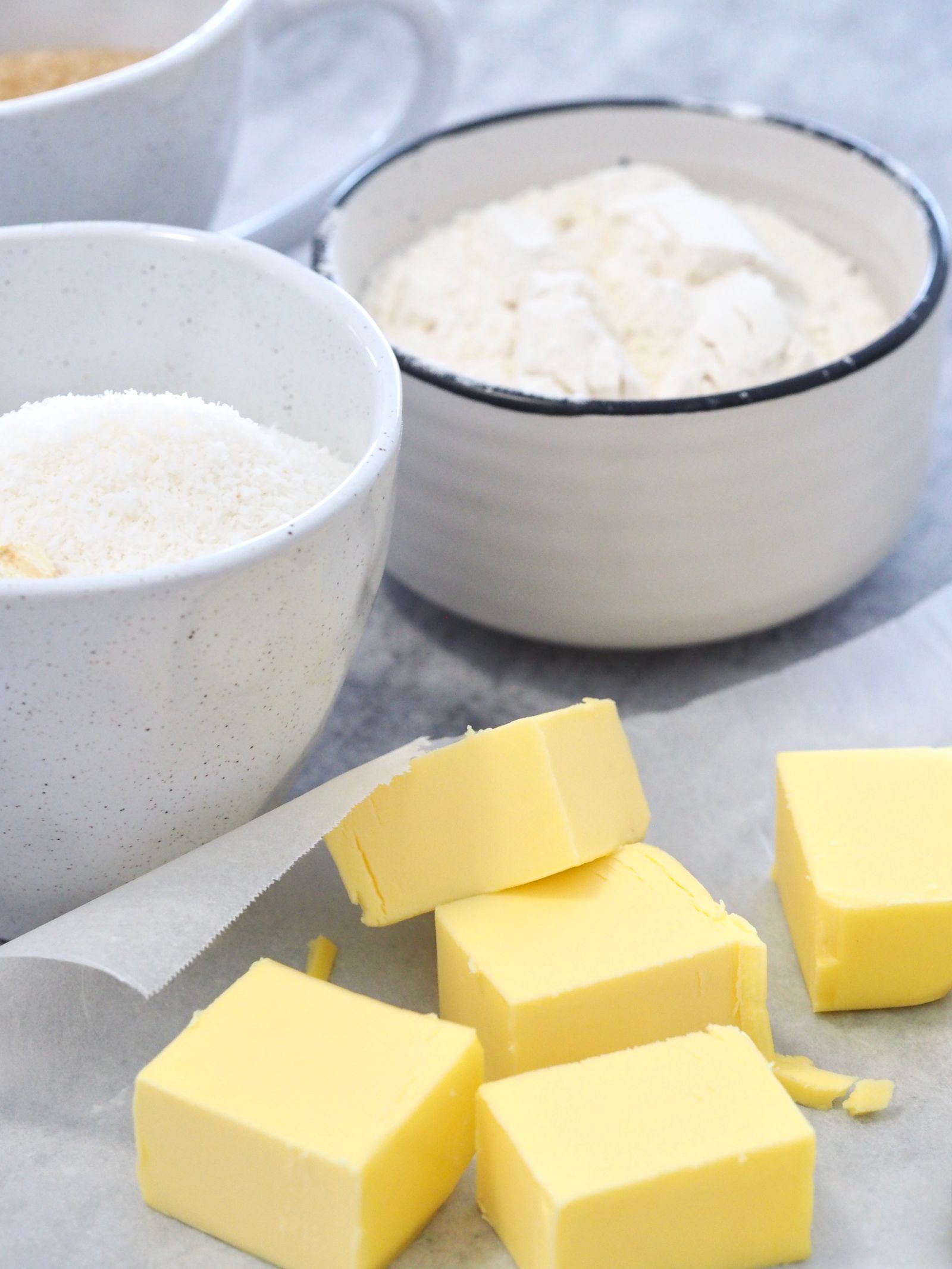
U.S. butter measurement reference
One stick equals 1/2 U.S. cup
A standard U.S. butter stick is one quarter pound: 1/2 cup, 8 tablespoons, 24 teaspoons, 4 ounces by weight, or about 113 grams. Two sticks equal one U.S. cup and about 227 grams. Check the package weight first, because a metric block, half-stick, roll or tub is not automatically one U.S. stick.
The butter stick to cup conversion in one line
1 U.S. stick
1/2 cup
8 tbsp · 4 oz · 113 g
2 U.S. sticks
1 cup
16 tbsp · 8 oz · 227 g
4 U.S. sticks
2 cups
32 tbsp · 1 lb · 454 g
Mental shortcut: divide sticks by two to get cups; multiply cups by two to get sticks. Land O’Lakes publishes the same practical equivalence for its full sticks, and King Arthur Baking lists 8 tablespoons or 1/2 cup of butter as 4 ounces and 113 grams.
Butter sticks to cups: the quick conversion chart
This chart assumes a standard U.S. quarter-pound stick. Gram figures are rounded for kitchen use. For formulation, costing, nutrition or fill-weight control, keep one documented conversion factor and round only at the final step.
| U.S. stick amount | Cup and spoon equivalent | Approximate weight |
|---|---|---|
| 1/8 stick | 1/16 cup · 1 tablespoon | 1/2 oz · 14 g |
| 1/4 stick | 1/8 cup · 2 tablespoons | 1 oz · 28 g |
| 1/2 stick | 1/4 cup · 4 tablespoons | 2 oz · 57 g |
| 2/3 stick | 1/3 cup · 5 1/3 tablespoons | 2 2/3 oz · 76 g |
| 1 stick | 1/2 cup · 8 tablespoons | 4 oz · 113 g |
| 1 1/2 sticks | 3/4 cup · 12 tablespoons | 6 oz · 170 g |
| 2 sticks | 1 cup · 16 tablespoons | 8 oz · 227 g |
| 3 sticks | 1 1/2 cups · 24 tablespoons | 12 oz · 340 g |
| 4 sticks | 2 cups · 32 tablespoons | 16 oz / 1 lb · 454 g |
The table uses rounded kitchen values. One quarter of the exact international avoirdupois pound is 113.3980925 g.
Four formulas cover almost any amount
Use decimal amounts for the calculation, then convert the result to a familiar fraction if needed. These equations only apply when “stick” means a standard U.S. 4-ounce stick.
Sticks to cups
cups = sticks ÷ 2
5 sticks ÷ 2 = 2.5 cups.
Cups to sticks
sticks = cups × 2
1.25 cups × 2 = 2.5 sticks.
Sticks to tablespoons
tbsp = sticks × 8
2.75 sticks × 8 = 22 tbsp.
Sticks to grams
grams ≈ sticks × 113.4
7 sticks ≈ 794 g.
How to measure part of a butter stick
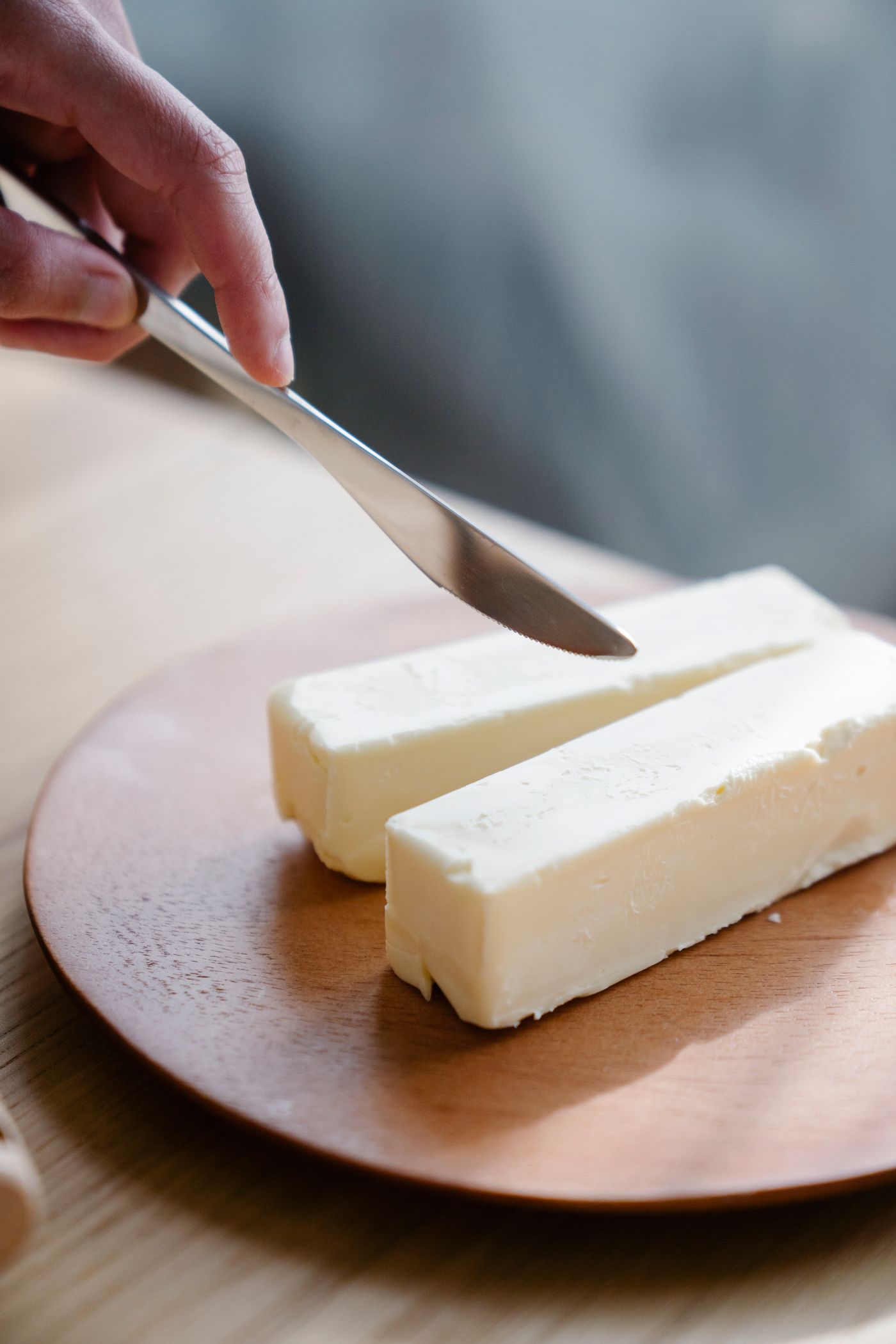
First confirm that the wrapped unit says 4 ounces or about 113 grams. Many U.S. wrappers divide a full stick into eight tablespoon portions; some also show 1/4-cup, 1/3-cup and 1/2-cup references. Land O’Lakes describes each mark on its full-stick wrapper as one tablespoon.
- Keep the wrapper on. It supports the butter and keeps the cutting marks aligned.
- Find the needed line. Two tablespoons equal 1/4 stick; four equal 1/2 stick; six equal 3/4 stick.
- Cut straight down. If the butter smears across the line, chill it briefly before cutting.
- Weigh awkward fractions. For 1/3 cup, use about 76 g or 5 tablespoons plus 1 teaspoon instead of estimating by eye.
What if the butter has no wrapper marks?
A digital scale is the simplest answer. Set an empty bowl on the scale, press tare, and add butter until the display reaches the recipe quantity. For one U.S. stick use about 113 g; for half a stick use about 57 g; for one U.S. cup use about 227 g. This works with blocks, tubs and uneven leftovers without asking the butter to hold a particular shape.
Pressing softened butter into a dry measuring cup is acceptable when a scale is unavailable, but remove large air pockets and level the top. Water displacement is messier and can leave water on the butter, so it is not the preferred method for repeatable baking. Avoid converting a tub by its printed container capacity: a 250 mL package describes available volume, not automatically 250 g of butter or one metric cup of usable product.
Why sticks, cups, ounces and grams are not the same kind of unit
A stick is a package portion. A cup, tablespoon and fluid ounce measure volume. An ounce printed as net weight and a gram measure mass. The familiar butter equivalence works because the standard U.S. stick has a known net weight and U.S. recipes consistently map that portion to a practical cup volume.
4 oz butter
This is mass: one quarter pound, or one standard stick. It is not a general rule that every 4-ounce food fills half a cup.
4 U.S. fl oz
This is volume: half of an 8-fluid-ounce U.S. cup. The matching numeral is coincidental and ingredient-specific.
113 g butter
This is the rounded metric mass of a U.S. stick. It is the safest translation when the local package is a block rather than a stick.
NIST lists approximate U.S. customary conversions of 28.35 g per ounce, 14.79 mL per tablespoon and about 0.24 L per cup. Exact mass conversions give 453.59237 g per pound, so one quarter pound is 113.3980925 g.
A U.S. butter stick is not a universal package
USDA describes quarter-pound sticks and one-pound solids among common U.S. butter packaging formats, alongside cups, chips and bulk packs. That makes “stick” a regional package convention, not an SI or internationally fixed cooking unit.
250 g block
about 2.20 sticks
Half the block is 125 g, not one U.S. stick.
454 g block
about 4 sticks
Weigh 113 g for one stick or 227 g for one U.S. cup.
500 g block
about 4.41 sticks
Use grams instead of cutting the block into assumed U.S. portions.
U.S. cup versus metric cup
Health Canada’s household-measure table distinguishes a U.S. cup of 236.6 mL from a 250 mL metric cup. The difference is 13.4 mL, or roughly 5.7%. For butter, bypass that drift: translate one U.S. stick to about 113 g and one U.S. cup of butter to about 227 g.
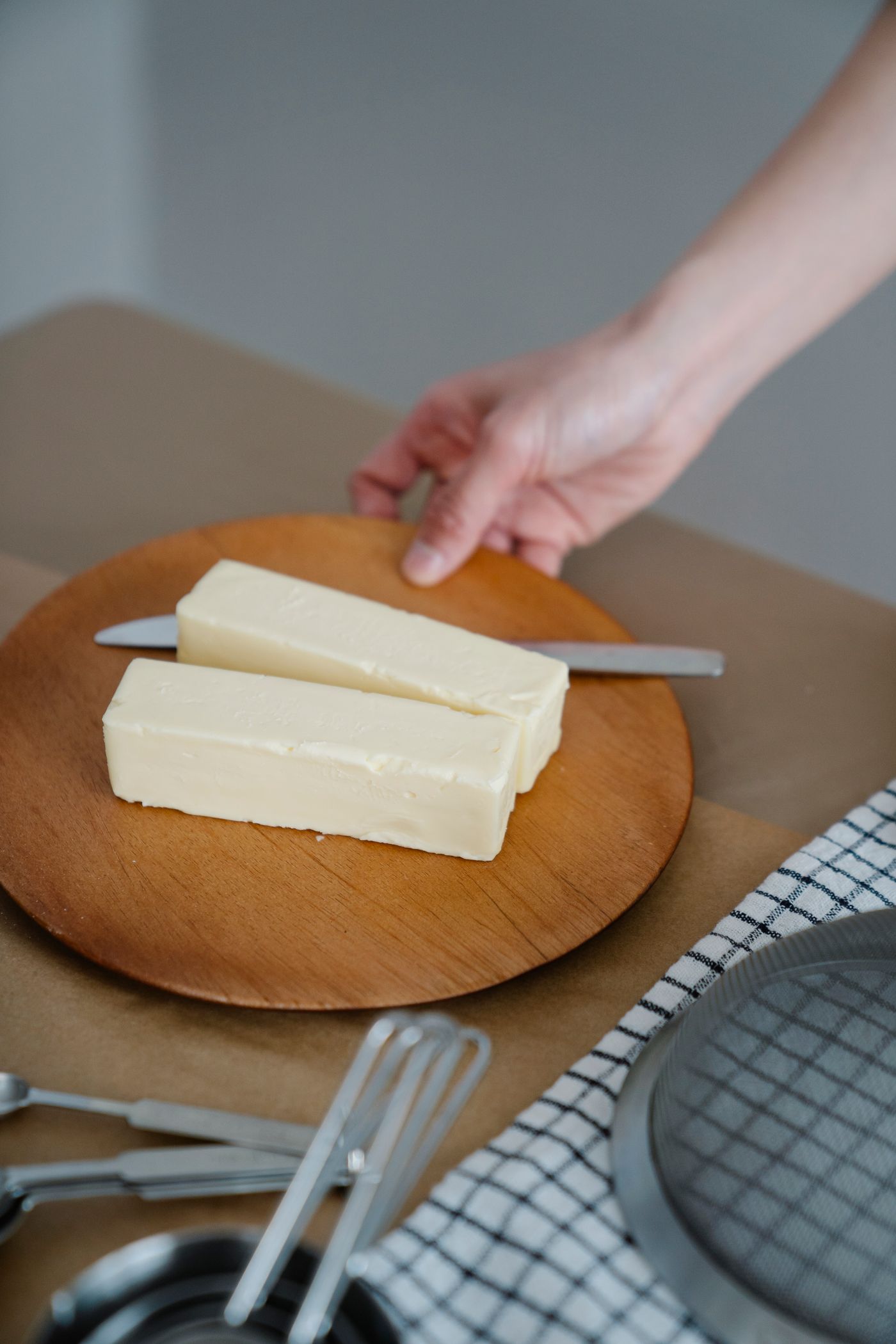
Cold, softened and melted butter: same amount, different function
Softening or melting does not change the starting mass of an intact stick. What changes is measurement reliability and how the fat behaves in the recipe. Residue left in a pan, foam, incomplete transfer and prolonged heating can alter the quantity that reaches the bowl.
Read melted-butter wording before you measure
Recipe punctuation often signals the sequence, but wording is not perfectly standardized. When texture depends on the difference, follow the author’s method or use the supplied gram quantity.
“1/2 cup butter, melted”
Usually means measure one stick or about 113 g first, then melt it. The preparation follows the measured ingredient.
“1/2 cup melted butter”
May mean melt first and fill a half-cup measure. If the recipe gives no method, 113 g is the conventional U.S.-stick starting point, but recipe context controls.
Browned butter is different: water evaporates and milk solids brown, so final mass is lower than starting mass. Follow a recipe’s stated starting quantity, target yield or replacement-water instruction instead of treating the final liquid volume as unmelted butter.
Do salted, unsalted and higher-fat butter convert the same?
Yes—if the package net weight is the same. A 4-ounce salted stick and a 4-ounce unsalted stick both equal one standard stick, one-half U.S. cup and about 113 g. Salt level is a separate recipe decision. If a recipe was developed with unsalted butter, any salt adjustment should follow the product label and recipe, not a generic stick conversion.
European-style or higher-fat butter also keeps the same unit conversion when its stick weighs 4 ounces. However, fat, moisture, plasticity and flavor can change spread, tenderness, lamination and emulsion behavior. USDA states that U.S. butter contains at least 80% milkfat by weight; equal quantity does not guarantee identical formulation performance.
What about margarine, whipped butter, tub spreads or ghee?
Convert the physical amount only when the alternative package truly declares the same mass. Do not assume a functional one-for-one substitute. Whipped products incorporate air; tub spreads may have different fat and water systems; ghee and clarified butter have much of the water and nonfat solids removed. A conversion answers how much. A substitution decision must also answer whether fat, water, milk solids, salt, flavor, melting and aeration remain suitable for the recipe.
How to scale butter for a bakery or production formula
Sticks and cups are convenient for small U.S. recipes. Grams or kilograms are easier to verify in production, work across package formats and reduce ambiguity. Convert once, document the factor and keep one unit system through the master formula.
10 sticks
1.134 kg
Equivalent to 5 U.S. cups or 2.5 lb.
24 sticks
2.722 kg
Equivalent to 12 U.S. cups or 6 lb.
40 sticks
4.536 kg
Equivalent to 20 U.S. cups or 10 lb.
- Confirm that the original “stick” is a U.S. quarter-pound stick and that “cup” is U.S. customary.
- Convert the complete formula to grams using one approved factor; do not mix 113 g and 113.398 g inside one calculation.
- Set rounding to the plant’s approved scale resolution and batch-control procedure.
- Run a controlled batch and confirm yield, dough or batter behavior, sensory result and process conditions.
- Lock the approved gram quantity in the master formula; retain sticks or cups only as secondary guidance.

For butter brands: make portion information easy to verify
A consumer conversion chart and a packaging specification solve different problems. The chart helps a cook translate a declared portion. The package must communicate the correct identity and quantity and protect the finished product under its validated conditions. A conversion-friendly wrapper or label can improve usability, but it never replaces net-content control or market-specific label review.
Net quantity
State the unit and total quantity clearly. Do not let familiar geometry imply a 4-ounce stick or a particular cup equivalent.
Portion marks
If artwork shows tablespoons or fractions, verify division logic and print registration under normal filling and wrapping conditions.
Dual-unit clarity
Distinguish ounces by weight from fluid ounces, and consider grams where products or recipes cross metric markets.
For tub or IML formats, package volume is not the same as butter mass. Review the declared fill, headspace, product density, closure, artwork area and intended line together. Honokage’s live butter container range and example 250 ml IML butter container can be used as format references; confirm final specifications for the selected product, market and production lot.

Package QA checks that support reliable communication
- Verify approved artwork, unit statement and revision control before production.
- Check print registration and legibility at start-up, normal speed and after roll or mold changes.
- Sample fill or net content under the applicable quality plan; do not infer it from container capacity.
- Evaluate closure, seal, stacking and distribution performance for the actual butter or spread.
- Run a simple user test when portion directions form part of the artwork.
See Honokage’s container testing overview as a starting point. Treat supplier website descriptions as project inputs that require confirmation against the approved construction and test plan.
Seven common butter conversion mistakes
Assuming every bar is one stick.
Read the net weight. Shape alone does not establish a 4-ounce portion.
Calling 4 oz “4 fluid ounces.”
Label mass as oz by weight and volume as fl oz or cups.
Using half a 250 g block.
Half is 125 g; a standard U.S. stick is about 113 g.
Using a 250 mL cup for a U.S. recipe.
For one U.S. cup of butter, use about 227 g.
Eyeballing 1/3 cup.
Use about 76 g or 5 tablespoons plus 1 teaspoon.
Partly melting butter for creaming.
The quantity is right, but the physical function may be wrong.
Mixing rounding rules in scale-up.
Choose one factor, calculate in grams and round once at the controlled final step.
Butter conversion FAQs
How much is one stick of butter in cups?
One standard U.S. stick equals 1/2 U.S. cup. It also equals 8 tablespoons, 24 teaspoons, 4 ounces by weight, one quarter pound or approximately 113 grams.
How many sticks of butter are in one cup?
Two standard U.S. sticks equal one U.S. cup, 16 tablespoons, 8 ounces by weight or about 227 grams.
How many sticks are in 3/4 cup?
Three-quarters of a U.S. cup equals 1 1/2 sticks, 12 tablespoons, 6 ounces by weight or about 170 grams.
Is a stick of butter always 113 grams?
No. A standard U.S. quarter-pound stick is approximately 113.4 g, but “stick” is a package convention. Half-sticks, metric bars, rolls and specialty portions may have different weights.
Does melted butter still equal 1/2 cup?
The starting mass remains the same when a stick melts. Volume readings can vary because of foam, residue, incomplete transfer or extended heating. Unless the method explicitly says otherwise, count or weigh first and then melt.
Can I use margarine with the same chart?
You can convert the physical package amount if a margarine stick truly weighs 4 ounces or about 113 g. That does not prove it will perform like butter. Check fat, water, salt, emulsion and recipe guidance.
What should I do when only metric butter blocks are available?
Weigh about 113 g for each U.S. stick or about 227 g for each U.S. cup of butter. This avoids assumptions about local block size and cup capacity.
Final recommendation
For everyday U.S. recipes, remember one line: 1 stick = 1/2 cup = 8 tablespoons = 4 ounces by weight = about 113 grams. Divide sticks by two to get cups; multiply cups by two to get sticks. Wrapper marks are convenient for common fractions, while a digital scale is better for awkward amounts, metric packages and repeatable baking.
Before applying the chart, confirm that the product is a standard U.S. quarter-pound stick. Treat temperature, composition and substitution as separate questions: the amount can convert correctly while the ingredient behaves differently in the recipe.
Technical references
- Land O’Lakes Butter Conversion Calculator — stick, cup, tablespoon, ounce, gram and wrapper-mark equivalents.
- King Arthur Baking Ingredient Weight Chart — 8 tablespoons or 1/2 cup butter listed as 4 ounces and 113 g.
- USDA AMS Butter Grading Information — butter identity, milkfat minimum and U.S. packaging formats.
- NIST Approximate Conversions — customary mass and volume relationships for kitchen use.
- NIST Guide to the SI, Appendix B — exact conversion factors for controlled calculations.
- Health Canada Canadian Nutrient File Users Guide — U.S. and metric household-measure comparison.
Butter and spread packaging projects
Define the fill, format and artwork before selecting a container
Share the product type, target fill, container size, decoration, closure expectations, market and validation needs so the packaging discussion starts with measurable requirements.