


Quick answer
Five U.S. liquid gallons equals 18.92706 L, usually stated as 18.927 L. Five Imperial gallons equals 22.73045 L.
The gallon system must be stated before a buyer approves a drawing, fill declaration, label, or tooling route. A five-gallon pail is normally a nominal size class. Its brimful volume may be higher, but that extra volume is not automatically usable headspace or permission to fill to the rim.
Buyer rule: specify U.S. gallons or liters, then define nominal volume, documented brimful volume, target net fill, minimum headspace, product density, lid, and maximum gross mass separately.
The capacity question has four parts
Exact conversion
How much is five U.S. gallons in other units?
NIST lists one U.S. gallon as 3.785412 liters. The conversion table below uses that factor and the U.S. gallon’s 231-cubic-inch definition. These are liquid-volume equivalents, not outside shipping dimensions or product weights.
Conversions are rounded for practical presentation. Keep more digits when a controlled calculation, calibration, or legal declaration requires them.
U.S. versus Imperial
Why can “five gallons” describe two different volumes?
A U.S. liquid gallon is 3.785412 L. An Imperial gallon is 4.54609 L. Five Imperial gallons is therefore 22.73045 L, about 3.80 L more than five U.S. gallons. Relative to the U.S. value, that is about 20% more volume.
This difference can change a package drawing, artwork declaration, batch sheet, net mass, freight plan, and filling-machine setup. Canada uses metric labeling for most commercial work, yet “gallon” can still appear in conversation. An international RFQ should never leave the convention unstated.
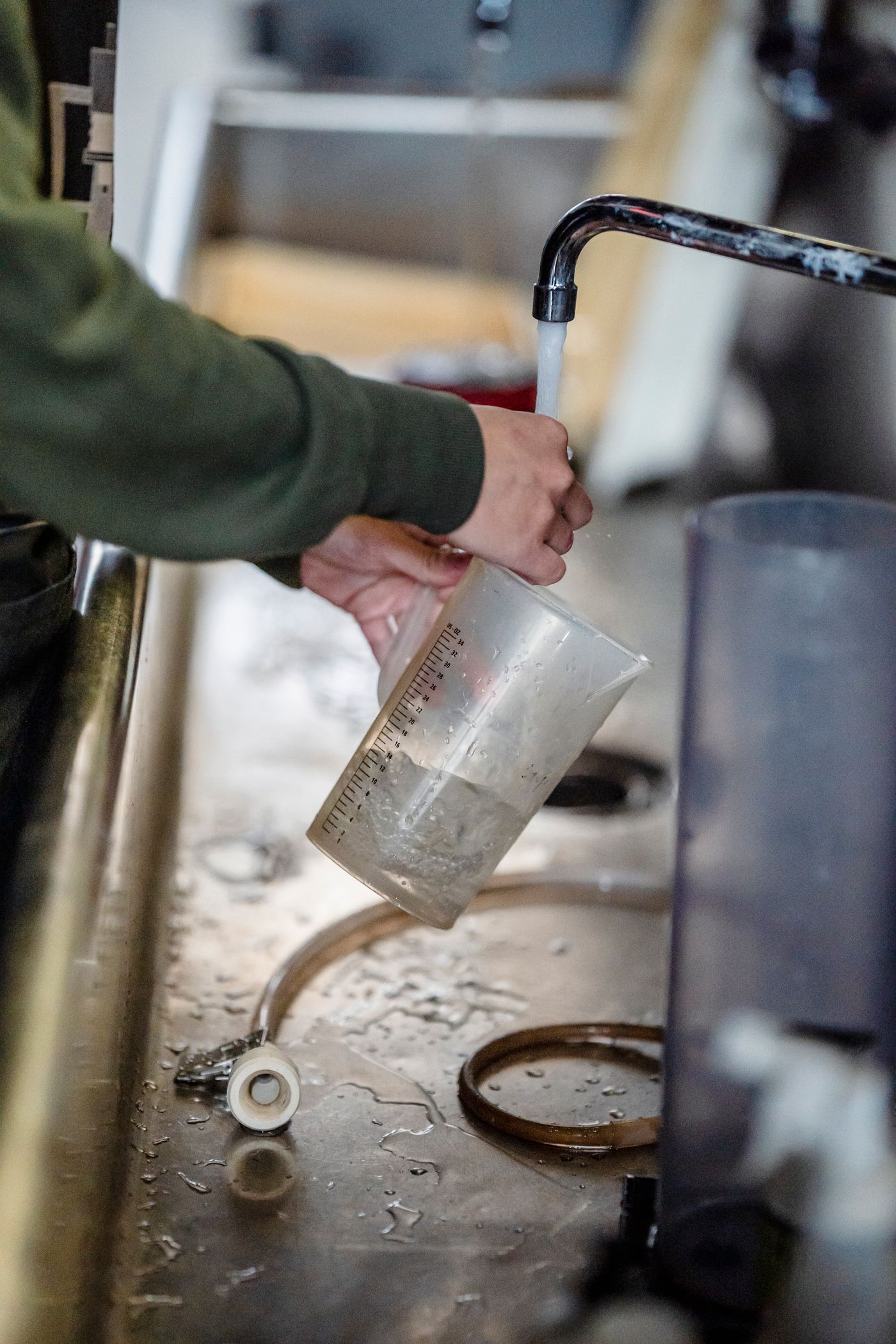
A controlled water-fill test needs a verified scale or measuring vessel, a defined fill line, and recorded temperature. Image: Annushka Ahuja / Pexels.
Capacity terms
What is the difference between nominal, brimful, and working capacity?
Nominal capacity is the stated size class or intended rated volume, such as 5.000 U.S. gallons. Brimful or overflow capacity is the maximum liquid volume at the overflow point under a defined method, usually with the pail upright and open. Working fill is the production target chosen for the actual contents, filling process, closure, and route.
The difference is visible in real manufacturer data. Container Supply Company publishes 5.44 ± 0.10 gallons as the brimful capacity for one nominal five-gallon HDPE pail. Uline publishes 5.2 gallons as overflow capacity for its S-16970 economy pail. These examples prove that overflow volume is design-specific; they do not create a universal 0.2- or 0.44-gallon headspace rule.
A useful geometric relationship is headspace volume = documented brimful volume – actual fill volume. But geometric headspace is only the starting point. Product expansion, foaming, trapped air, particulate settling, filling temperature, closure intrusion, venting, pressure, distribution shocks, and applicable rules can require a larger working margin.
Dimensions and measurement
Does every 5 gallon bucket have the same dimensions?
No. Pails are often tapered so empty units can nest. Top and bottom diameter, height, wall thickness, base shape, rim, cover depth, gasket, tear band, handle, label area, and stacking features vary by supplier and product family. Two pails can share a five-gallon label yet differ enough to affect lids, filling equipment, pallet patterns, and warehouse cube.
Do not calculate commercial capacity from outside height and diameter. A pail is closer to a truncated cone than a cylinder, and external dimensions include plastic walls, a base, rim geometry, and possibly a lid. If internal top radius R, internal bottom radius r, and usable internal height h are known, a preliminary estimate is:
V = (πh / 3) × (R² + Rr + r²)
Use internal dimensions and measure height only to the intended fill line. Treat the result as an engineering estimate. A supplier drawing or a controlled fill test with the exact pail and lid is stronger evidence. For common size context, see Honokage’s live guide to five-gallon bucket dimensions, but approve only the drawing for the chosen SKU.
Density and weight
How much does a full 5 gallon bucket weigh?
Capacity is volume, not weight. Five U.S. gallons of water weighs about 41.7 lb (18.9 kg) at ordinary field precision, before adding the pail and lid. Use that as a planning estimate because water density changes slightly with temperature.
Metric formula: net mass (kg) = actual fill volume (L) × product density (kg/L). Gross mass adds the pail, lid, gasket, liner, handle, tamper feature, label, and any other packaging.
Dry powders, pellets, grains, flour, sand, or granules need bulk density rather than liquid density. Particle size, moisture, aeration, vibration, and settling can change the result. Specify a density range, fill method, target net mass, and settling allowance, then confirm with production samples. For more examples, see Honokage’s guide to five-gallon bucket weight.
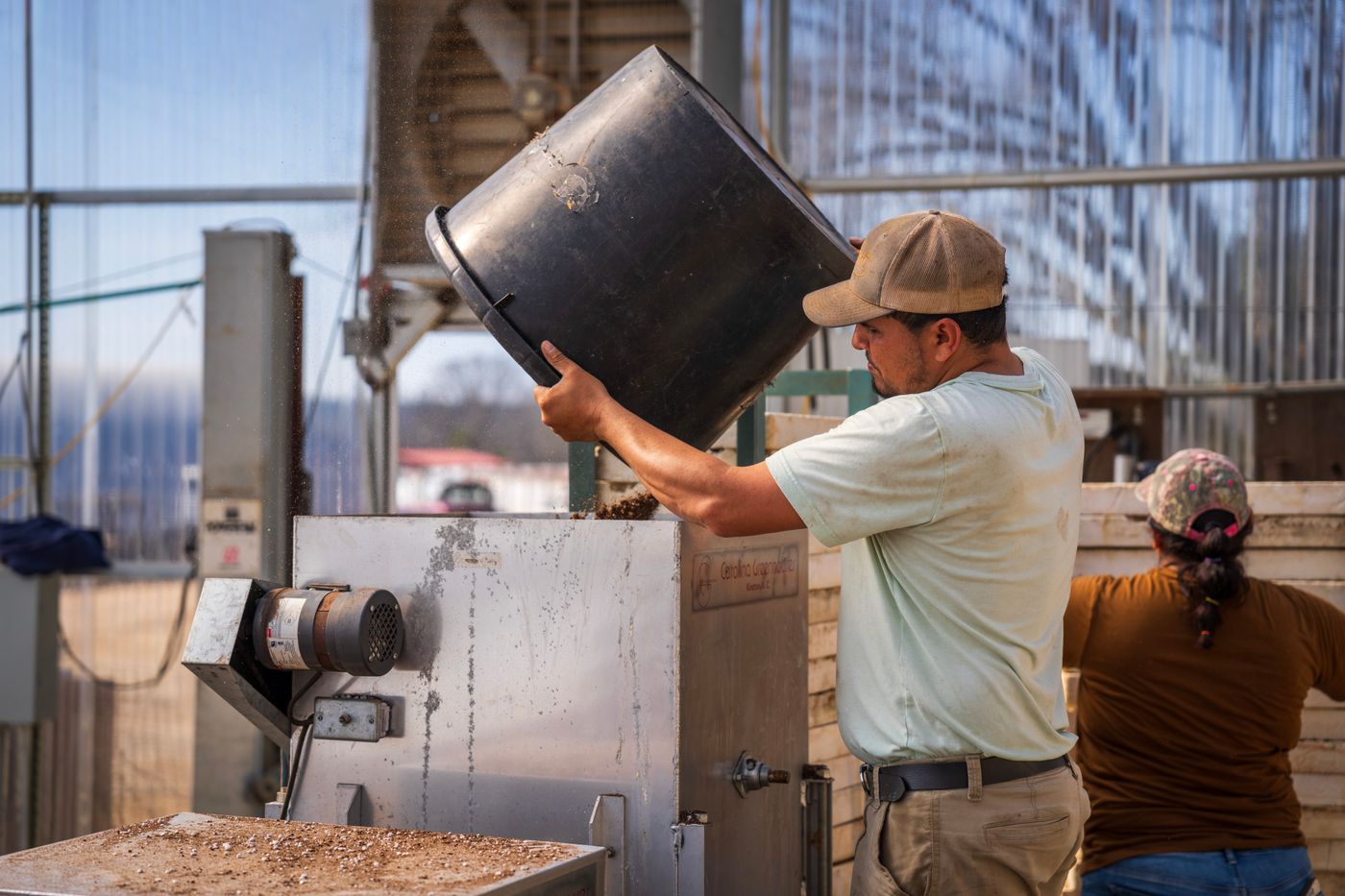
A full pail can become a serious manual-handling task; assess the real weight, reach, frequency, grip, and work environment. Image: Mark Stebnicki / Pexels.
Handling and stacking
Why is bucket volume not a safe load or lift rating?
A water-filled pail already contains about 42 lb. A denser liquid can exceed 50 lb before packaging is added. The handle, rim, lid, wall, and bottom must all survive the intended route, while the person or equipment moving the pack faces a separate handling risk.
A published top-load or stack-compression figure is not a manual-carry limit. It may describe a short laboratory compression condition, not long storage, a moving pallet, a hot warehouse, creep under load, an uneven stack, or a person’s safe lifting capacity. Ask for the method, conditioning, duration, safety factor, and allowed deformation.
NIOSH’s Revised Lifting Equation treats manual lifting as task-specific. Object weight is only one input. Horizontal and vertical reach, travel distance, twisting, lifting frequency, task duration, and grip quality also matter. Decide whether filled pails will be hand-carried, placed on a dolly, conveyed, palletized, or mechanically lifted, then assess the whole task.
Operations and logistics
How does bucket capacity affect filling and freight planning?
The 0.6684 ft³ conversion describes the liquid inside. It cannot be multiplied by the number of pails to obtain an accurate warehouse or freight cube. Closed pails have larger outside dimensions, and the handle, lid overhang, nesting shape, pallet clearance, stretch wrap, corner protection, and allowed stack pattern add space.
The filling line also works from a real container, not a unit conversion. A new pail can change conveyor guides, denesting, nozzle position, fill-height sensing, lid application, code location, checkweigher limits, accumulation, and case or pallet handling. Approve line trials before assuming that two nominal five-gallon pails are interchangeable.

Suitability and compliance
Does “HDPE,” “food grade,” or “UN rated” follow from capacity?
No. These labels answer different questions. A nominal capacity gives none of them. Review the exact product, complete package, intended contents, use conditions, and supporting documents.
Material identity
HDPE and PP identify polymer families. Resin code #2 or #5 helps material sorting; it does not authorize every color, lid, liner, ink, adhesive, or use.
Food-contact suitability
FDA explains that the status of a food-contact material depends on each relevant substance and its intended conditions of use. Ask for product- and market-specific evidence.
UN/DOT configuration
A hazardous-material marking belongs to a tested design type, contents class, packing group, mass or density limit, closure method, and transport rules.
Under 49 CFR §178.509, a removable-head plastic drum uses the code 1H2, and its closures must remain secure and leakproof under normal conditions of transport. That general section does not make every five-gallon pail a compliant dangerous-goods package. Performance testing, marking, assembly, compatibility, and use requirements still apply.
A marking such as M&M Industries’ published 1H2/Y27/S example must be read narrowly: the “S” context is for solids, and the marking belongs to the stated M2 pail-and-cover configuration. A similar-looking economy pail may expressly be non-UN-rated. Never transfer a rating from one pail, lid, gasket, plant, or closure method to another.
RFQ-ready specification
What should a five-gallon pail buyer specify?
Replace “send me a five-gallon bucket” with a package definition that production, quality, logistics, and the supplier can all verify.
How should buyers use Honokage’s product information?
Honokage publishes a five-gallon ice cream bucket in polypropylene with a custom-made brimful volume, injection-molded construction, IML decoration, frozen-use positioning, and a safety-lock feature.
Those are supplier-published starting points, not a completed specification for every product. Confirm the actual drawing, target volume, lid and tamper system, decoration, food-contact basis, fill and hardening process, low-temperature performance, pallet route, and acceptance tests.
Honokage also publishes a broader food-grade plastic bucket range. Do not assume that one configuration, material statement, lid, or use claim applies to every item in the range.

Translate supplier testing into written project methods, sample sizes, limits, and responsibilities. See Honokage’s testing overview.
Common mistakes
Six five-gallon bucket mistakes to avoid
Frequently asked questions
Five-gallon bucket capacity FAQ
How many liters are in a 5 gallon bucket?
Five U.S. gallons equals 18.927 L. Five Imperial gallons equals 22.730 L. Confirm which gallon is meant before approving a fill target or supplier quotation.
Is a 5 gallon bucket exactly 20 liters?
No. A true 20 L volume is about 1.073 L larger than five U.S. gallons. The difference can affect net contents, headspace, artwork, gross weight, and equipment setup.
Does a 5 gallon bucket hold five gallons to the rim?
Not necessarily. Five gallons is normally the nominal capacity. Brimful volume varies by pail design and measurement method. Use the supplier’s documented value and a validated working fill.
How much does five gallons of water weigh?
About 41.7 lb (18.9 kg) before the pail and lid are added. Water density changes slightly with temperature, so use this as an operating estimate rather than a calibration value.
How many cubic feet are in five gallons?
Five U.S. gallons equals about 0.6684 ft³ of liquid volume. The outside warehouse cube is larger because it includes the tapered pail, lid, handle, spacing, carton, and pallet pattern.
How much headspace should a five-gallon pail have?
There is no universal percentage. Product expansion, foaming, fill temperature, pressure, closure geometry, transport, and regulations determine the requirement. Prove it with the exact filled package.
Is every HDPE or PP bucket food grade?
No. Polymer identity alone does not establish the regulatory status of every component or intended use. Review the pail, lid, gasket, colorant, print or label, food type, temperature, contact time, and target market.
Is every five-gallon pail UN rated?
No. Performance status belongs to a specific tested packaging design, marking, closure method, content class, packing group, limit, and transport route. Obtain the exact certificate or test basis and closure instructions.
Plan a bucket project
Turn “five gallon” into a usable packaging brief
Share the target market, U.S.-gallon or liter basis, product, density range, fill temperature, target net fill, minimum headspace, lid and liner, tamper requirement, decoration, pallet route, and required food-contact or dangerous-goods evidence. That gives the supplier enough context to recommend a configuration and test plan.
Supplier pages describe available products and capabilities. Final capacity, performance, compliance, shelf life, and suitability require project-specific confirmation.
Final recommendation
Use 18.927 L as the capacity of five U.S. gallons, then stop treating that number as the whole specification.
For real use, define the gallon standard, nominal and brimful volume, working fill, headspace, product density, gross mass, exact pail and lid, handling route, compliance evidence, and validation method. That is the difference between a bucket that is merely called “five gallon” and a package that performs reliably.
Sources and further reading
- NIST Guide to the SI: U.S. and Imperial gallon conversion factors
- Container Supply Company: five-gallon round pail specification
- Uline S-16970 five-gallon economy pail specification
- M&M Industries: 5.0 M2 pail product data
- FDA: regulatory status of food-contact material components
- FDA: food types and conditions of use
- eCFR: 49 CFR §178.509 plastic drums and jerricans
- NIOSH: Revised NIOSH Lifting Equation
- CPSC: In-Home Drowning Safety Information Center
This guide is educational and U.S.-oriented. It is not a fill-quantity authorization, food-contact legal opinion, ergonomic assessment, dangerous-goods classification, or substitute for the exact supplier drawing, closure instructions, test reports, and applicable regulations.