


Direct answer
Can you safely refreeze melted ice cream? The conservative answer is no. Discard ice cream that became liquid, softened throughout, sat at an unknown temperature, was involved in a power outage or may have been contaminated.
FoodSafety.gov’s power-outage chart lists ice cream and frozen yogurt as discard items even when ice crystals remain. University of Minnesota Extension separately advises not to refreeze ice cream and similar frozen desserts. These product-specific recommendations are stricter than the general refreezing rule for many meats, breads or fruits.
Do not use the two-hour rule as a rescue timer. FDA’s two-hour limit is an outside boundary for perishable food left at room temperature, not permission to keep melting ice cream on the counter. Return a still-frozen tub promptly; discard it when the condition or history is uncertain.
Three states that require different decisions
Keep, stop the warming cycle or discard
What should you do in each melted ice cream scenario?
This table is deliberately conservative. “Return to freezer” applies only when the product is still fundamentally frozen after a brief, clean serving event. It does not mean a thawed tub can be made new again.
The safe default is to discard when time, product temperature or contamination history cannot be verified. Follow manufacturer, local authority and qualified food-safety instructions when they are more specific.
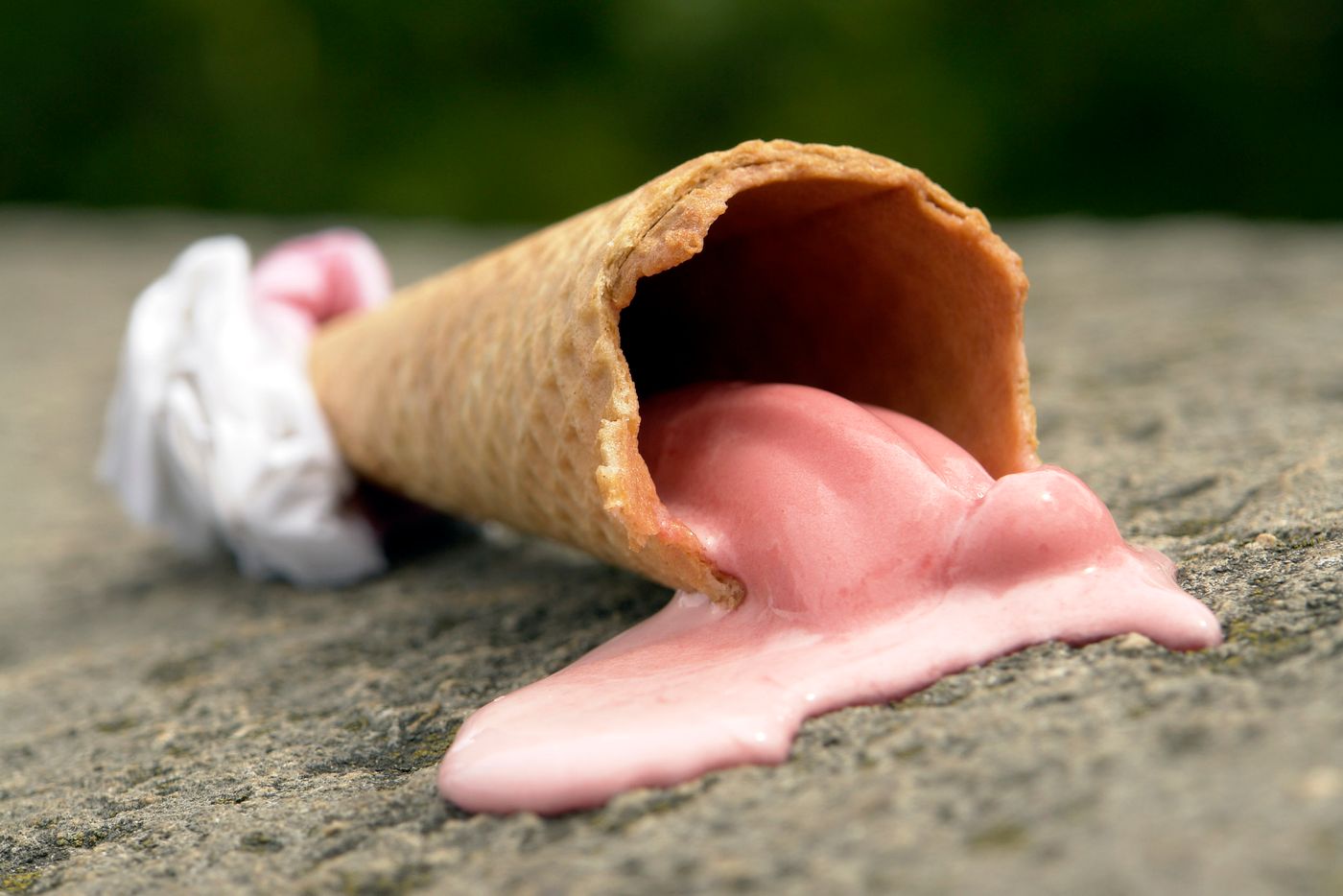
Once the product is fully melted, home freezing cannot recreate its original manufacturing history. Image: Tobias Baur / Pexels.
Safety and sensory quality are separate
Why does temperature history matter more than hardness?
A hard tub tells you its current state, not what happened before. FDA explains that freezing does not kill most bacteria; it stops growth while food stays properly frozen. If the product thaws, surviving microorganisms can become active under suitable conditions. Making it hard again does not undo that earlier interval.
Quality follows a different mechanism. A small temperature rise can melt part of the ice phase long before the tub looks liquid. That means a product may remain cold enough to limit one type of safety concern yet still become icy and dense. Conversely, a melted product can look and smell ordinary even though its warm time or sanitation history cannot be cleared.
Never taste questionable ice cream to test safety. Normal smell or flavor cannot recover missing temperature records, and FoodSafety.gov explicitly warns against tasting food after an outage to determine whether it is safe.
The structure cannot simply be reset
Why does refrozen ice cream become grainy and dense?
Ice cream is a partly frozen foam. Its smoothness depends on many small ice crystals, dispersed air cells, fat globules and a partially coalesced fat network, milk proteins, emulsifiers, stabilizers and a concentrated unfrozen liquid containing sugars and salts. Industrial freezing creates these structures together; rapid hardening then locks much of the arrangement in place.
The University of Guelph’s Ice Cream Technology eBook explains that not all water is frozen at normal ice cream temperatures. When the temperature rises, the balance between ice and unfrozen liquid changes. Smaller crystals partially melt, the liquid phase becomes more mobile and the foam loses support. Once enough ice melts, air cells can merge or escape and the fat-stabilized structure can collapse.
During slower refreezing, water tends to join the surviving crystals rather than recreate the original population of many tiny crystals. Small crystals disappear, larger ones grow and some fuse. The tongue detects those enlarged crystals as icy, coarse or crunchy. Static freezing also does not whip lost air back into the product, so the new block can feel heavy, shrunken or unusually hard.
A colder household setting may shorten the time spent warm, but it cannot reconstruct the original crystal distribution and overrun. This is why “freeze it colder” is prevention of further loss, not restoration.
Limited damage control
What can you do if the ice cream is only slightly softened?
This recommendation applies only to a normal serving event: the surface became scoopable, the bulk and center stayed firmly frozen, the exposure was brief, the container remained intact and only clean utensils touched the product. It is a practical handling inference, not an exception to the power-outage discard chart.
Do not stir, blend or add freezing agents to the retail tub. Stirring can spread melted regions, collapse more air and introduce contamination. Dry ice, liquid nitrogen, salt or alcohol require product-specific professional controls and are not household repair methods.
Not a home rescue method
Can you re-churn melted store-bought ice cream?
An ice cream machine can create small crystals and incorporate air when it processes a correctly formulated, pasteurized mix under clean, controlled conditions. That does not make re-churning a melted retail carton a general safety fix. The carton already contains a finished formula, established overrun, fat network, inclusions and stabilizer system designed for one production cycle.
More importantly, re-churning cannot erase a missing time-temperature record or contamination from hands, utensils, an open package or raw-food drips. A visibly smoother result would still not prove a safe history. Consumers should follow conservative discard guidance instead of trying to reproduce factory processing at home.
Commercial rework is different. A manufacturer may have an approved, validated process with hold-and-release authority, allergen segregation, sanitation verification, lot traceability, defined eligibility, product-specific quality assessment and regulatory review. If that written process does not exist, disposal is the defensible decision.

Scenario response
How should you handle an outage, delivery delay or serving mistake?
Power outage
Keep the freezer closed while power is out. Afterward, use the FoodSafety.gov product chart and discard ice cream and frozen yogurt even if crystals remain.
Soft delivery
Photograph the condition, record delivery time and request a replacement. Do not hide a last-mile temperature failure by putting the tub in your freezer.
Warm car
A parked or sun-heated car is not controlled refrigeration. Discard a tub that became soft throughout or liquid, especially when timing is uncertain.
Freezer door left open
Check the appliance thermometer and product condition. If the ice cream softened or the history is uncertain, use the conservative discard action.
Tub left on table
Do not wait for the two-hour boundary. Put back a still-frozen tub promptly; discard one that melted or has an uncertain contamination history.
Retail cabinet excursion
Quarantine affected lots, review logged time and temperature, inspect package condition and follow the approved QA disposition matrix.
Prevent the decision next time
How can you keep ice cream from melting and refreezing?
Prevention protects both safety evidence and texture. FDA recommends keeping the freezer at 0°F (-18°C). An appliance thermometer is more informative than a numbered control dial because it shows whether the cabinet actually maintains the target.
For manufacturers, retailers and foodservice
What should a melted-ice-cream prevention plan control?
A strong quality plan prevents a questionable tub from reaching a casual refreeze decision. Map the product from dynamic freezing and hardening through cold storage, transport, retail display, last-mile delivery and serving. Air temperature alone is useful but may not represent the slowest-cooling center of a large tub or the fastest-warming outer case.
Commercial hardening is not the same as putting a melted carton in a storage freezer. Guelph describes rapid hardening with very cold air or plate conduction, and notes that container size, exposed surface, stacking, airflow and package type all affect heat transfer. Qualify the largest format and densest case arrangement, not only an easy laboratory sample.

Packaging inspection supports a cold-chain plan, but it cannot replace product temperature monitoring or food-safety disposition.
Packaging has a supporting role
Can a better ice cream tub prevent quality loss?
A well-designed tub and lid can reduce moisture loss, odor pickup, leakage, contamination and handling damage. It can also present clear storage and no-refreeze instructions. It cannot prevent internal crystals from melting when the product becomes too warm, and it cannot rebuild the original microstructure after complete melting.
The package should therefore be qualified as one part of the system. Container size and geometry influence the heat path during hardening. A large mass or tightly bundled case can cool slowly at the center. Secondary packaging that protects from later heat shock may impede early hardening if applied too soon. Lid fit that looks acceptable at room temperature should be checked after low-temperature conditioning and realistic handling.
Closure fit
Check lid retention, opening, reseal, rim consistency and leakage after freezer conditioning and handling.
Moisture and odor protection
Limit freezer burn, dehydration and foreign-odor pickup without claiming that barrier alone prevents heat shock.
Hardening compatibility
Validate fill mass, exposed area, case count, airflow clearance, stacking and center hardening time.
Instructions and traceability
Keep storage, handling, date and lot information legible after condensation, frost and abrasion.
Honokage publishes an ice cream container range, a testing overview, guidance on frozen-food packaging drop tests and a discussion of tamper-evident ice cream containers. These are project-starting references; final construction and claims require product-, process- and market-specific validation.
What should an ice cream tub RFQ specify?
- Product recipe, fill weight, density and inclusions
- Filling, dynamic freezing and hardening conditions
- Container size, wall map, lid and tamper-evident concept
- Case count, pallet pattern, airflow and bundling timing
- Cold storage, transport, retail and last-mile route
- Low-temperature fit, impact, stacking and leak checks
- Artwork durability, lot coding and consumer instructions
- Change-control triggers and production-intent sample plan

Example format only. Larger fill mass, geometry and case arrangement should be included in the hardening and distribution qualification.
Bad shortcuts
Five myths about refreezing melted ice cream
Frequently asked questions
Melted ice cream safety and quality FAQ
È sicuro ricongelare il gelato sciolto?
The conservative answer is no. Discard fully melted or substantially softened ice cream, especially when time, temperature or contamination history is unknown. Official U.S. outage and extension guidance is specifically cautious for ice cream.
Can I put slightly softened ice cream back in the freezer?
If only the surface softened briefly during clean serving, the center stayed firmly frozen and the tub remained continuously cold, close it and return it immediately to 0°F (-18°C). This limits further damage but does not restore what already melted.
How long can ice cream sit out?
Do not treat two hours as an acceptable serving target. FDA’s two-hour rule is a maximum boundary for perishables at room temperature, reduced to one hour above 90°F (32°C). Ice-cream-specific refreezing advice is more conservative.
Why is refrozen ice cream grainy?
Small ice crystals partially melt. During slower refreezing, water moves toward fewer surviving crystals, which grow large enough to feel coarse or crunchy. Air cells and the fat network may also collapse.
Does refreezing kill bacteria?
No. Freezing is not a reliable kill step. It stops most bacterial growth while food remains frozen, but microorganisms can become active after thawing. Refreezing also cannot reverse contamination.
Can I re-churn melted store-bought ice cream?
Do not use re-churning as a home safety fix. It cannot prove or repair the earlier thermal and contamination history, and it cannot reliably reproduce the manufacturer’s original structure.
Should ice cream be discarded after a power outage if crystals remain?
Yes. FoodSafety.gov’s frozen-food chart lists ice cream and frozen yogurt as discard items even in the column for products that still contain ice crystals and feel refrigerator-cold.
Can a better container stop ice crystal growth?
A suitable tub and lid can reduce dehydration, odor pickup and leakage, but cannot stop internal melting during a temperature excursion. Packaging, rapid hardening and a stable cold chain must work together.
Build prevention into the package brief
Discuss an ice cream tub around hardening, closure and real cold-chain handling
Share the recipe, fill weight, filling and hardening route, container size, case and pallet arrangement, freezer and delivery conditions, lid and tamper-evident concept, artwork, target market and test plan. Honokage can use those inputs to discuss an existing format or custom project; final performance and compliance require qualification for the selected construction and intended use.
Final recommendation
Prevent more melting; do not promise a full quality rescue
Fully melted ice cream should not be refrozen for later consumption. If a tub merely became scoopable at the surface during a short, clean serving period while its center remained firmly frozen, close it and return it immediately to a properly maintained freezer. That limits additional heat shock, but some small crystals may already have melted and can regrow larger.
When time, temperature, contamination, delivery or outage history is uncertain, discard without tasting. For brands and operators, prevention is the real quality solution: rapid hardening, stable storage, monitored transport, disciplined serving, suitable closure performance and an excursion plan that keeps questionable stock from quietly returning to sale.
Sources and further reading
- FoodSafety.gov: Food Safety During Power Outage — ice cream and frozen yogurt discard guidance and the instruction not to taste food for safety.
- University of Minnesota Extension: Preserving Food at Home—Freezing — reviewed 2025 advice not to refreeze ice cream and similar frozen desserts.
- FDA: Are You Storing Food Safely? — 0°F (-18°C) freezer guidance, two-hour boundary and the effect of freezing on bacteria.
- USDA FSIS: Freezing and Food Safety — rapid freezing, large crystals, general refreezing rules and the instruction to dispose of soft or melted ice cream.
- University of Guelph: Structure from the Ice Crystals — partly frozen foam structure, freeze concentration, ice crystals and air cells.
- University of Guelph: Theoretical Aspects of the Freezing Process — freezing rate, crystal size and mechanisms of recrystallization.
- University of Guelph: Hardening — rapid commercial hardening and the effects of airflow, container size, stacking and package type.
- Caldwell, Goff and Stanley: A Low-Temperature Scanning Electron Microscopy Study of Ice Cream — peer-reviewed description of frozen ice cream microstructure.
Editorial note: this is general U.S.-oriented information, not a microbiological test, medical recommendation, product-release procedure or substitute for manufacturer, local authority or qualified food-safety instructions. Commercial rework requires a validated facility-specific program.