


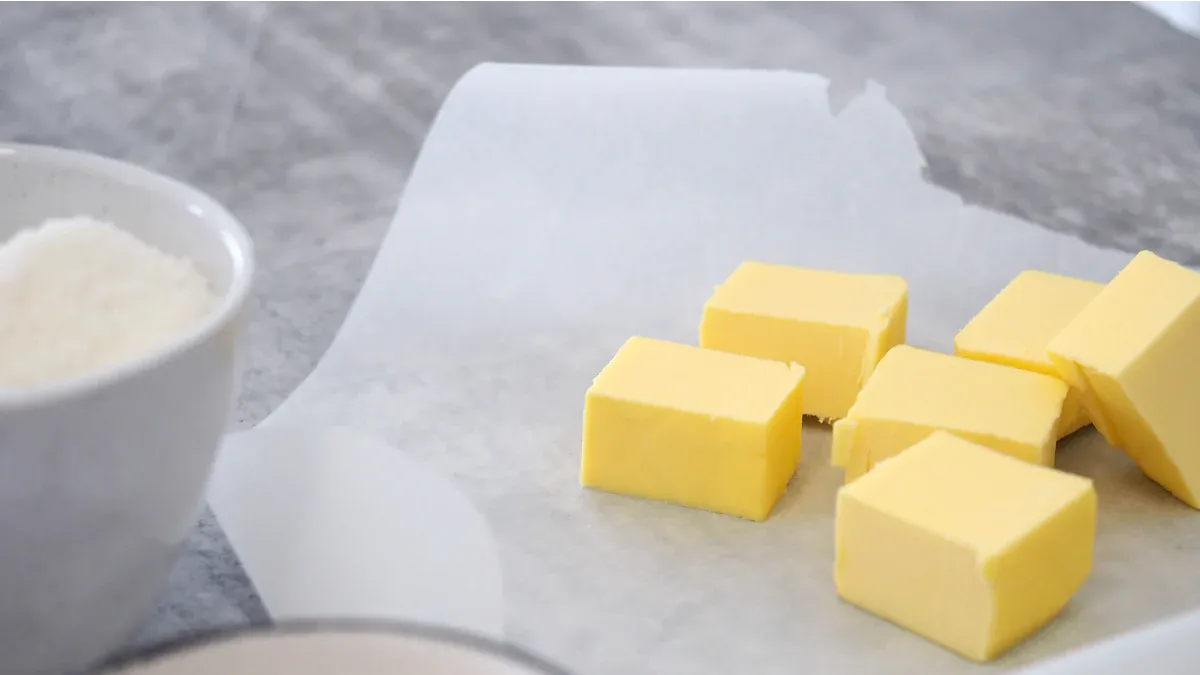
Quick answer
What is the best material for butter containers in 2026? Choose the package by butter format: foil-based wrap for firm blocks, a sealed PP or HDPE tub for soft products, and a covered opaque or dark-stored dish for a small household portion.
The material name is only the first decision. Butter packaging must manage light, grease, odor, moisture loss, opening, reclosure, cold handling, and food-contact requirements. A strong substrate can still fail through pinholes, weak folds, a warped tub rim, an incompatible membrane, or an unqualified ink or coating.
The useful rule: select the simplest complete package that protects the actual butter through its actual route, then prove the result with compliance, seal, sensory, shelf-life, and distribution evidence.
Start with the product format, not a material slogan
Use-case comparison
Which butter container material fits each use?
This table gives a starting route, not an approval. Commercial buyers still need the exact layer structure, closure, food-contact basis, and filled-pack test plan.
“Best starting system” means the first construction worth testing. It is not a universal shelf-life, food-safety, recycling, or regulatory approval.
The protection jobs
Why butter needs more than a greaseproof container
USDA defines butter as a dairy product containing at least 80% milkfat. That fat-rich composition matters because butter can absorb nearby odors and develop oxidized flavors. The package must also control surface drying, grease staining, handling damage, and contamination.
Tetra Pak’s dairy handbook says butter wrapping should resist grease and be impervious to light, flavoring and aromatic substances, and moisture. This explains why “it does not leak oil” is not a complete requirement. A greaseproof sheet can still transmit light, let aromas pass, or lose moisture through folds and edges.
Firm sticks and blocks
Why foil-based wraps remain the retail baseline
For a compact butter stick or block, the wrapper must stay close to the product, hold its fold, resist grease, limit light and odor exposure, and run on the packaging line. Tetra Pak identifies aluminium foil as the usual butter wrap and notes that it has largely replaced parchment because it is much less permeable. The wrapped portion commonly receives a paperboard carton for extra light, mechanical, and print support.
A peer-reviewed 1986 study compared ten wrapper materials under fluorescent light. In that test, an aluminium-foil paper laminate transmitted no measurable light and was the only tested construction that completely protected the butter from oxidation. This is strong evidence for light-barrier selection, but it is not a universal shelf-life promise for every foil thickness, laminate, fold, product, or retail case.
“Foil” also does not mean bare metal must contact every butter. Salt, acidity, coatings, inks, adhesives, and local rules can affect construction. A commercial wrapper may combine paper, foil, and polymer layers. Buyers should identify the butter-contact layer, barrier layer, print surface, adhesive or extrusion bond, and what happens at the fold and cut edges.

Soft and scoopable products
When PP or HDPE is better than a wrapper
Whipped, spreadable, and compound butter do not hold a neat fold-wrap shape. A rigid tub creates a defined fill cavity and rim. It also supports a peelable first-opening membrane and a reusable overcap. PP and HDPE are both common starting families, but the grade, wall design, rim, sealant, color, label, and lid determine the finished result.
PP tub
PP can provide useful stiffness at low package weight and is widely used for injection-molded food tubs. It can pair naturally with PP in-mold labels when a supplier is designing a PP-led construction.
Qualify: cold impact, hinge or snap performance, rim flatness, membrane seal window, pigment, label coverage, and actual food-contact grade.
HDPE tub or liner
HDPE can be a useful route when toughness, moisture resistance, or an opaque construction is important. It behaves differently from PP during molding and sealing.
Qualify: stiffness, creep, rim and lid fit, sealant compatibility, cold handling, opacity, decoration, and the exact authorized grade.
A clear tub is not a light barrier. A colored tub, opaque lid, full-coverage label, sleeve, or carton may be needed. The peel membrane should be treated as the primary first-opening barrier unless testing supports a different claim; a snap lid mainly supports handling and reclosure.

Material name versus evidence
“PP” is not a complete specification
Two containers marked PP can use different resin grades, pigments, additives, labels, inks, and manufacturing sites. They can also have different wall sections, rims, lids, and storage limits.
Honokage states that it uses PP for IML food-container projects. A buyer should still request the exact bill of materials, food-contact basis, intended use, dimensional drawing, and project test plan.
Do not convert a general website temperature or performance statement into a finished-pack guarantee. Confirm the actual grade, time, load, food, storage condition, test method, and acceptance criteria.
Paper-led structures
When parchment or coated paper can make sense
Paper-led packaging can suit a specialty product with a short local route, controlled display, and a deliberate tactile presentation. It can also be the printable or secondary layer around a stronger barrier. Plain parchment, however, should not be treated as equal to a foil laminate simply because both fold around butter.
The Wisconsin Center for Dairy Research explains that common parchment can transmit light, allow outside flavors in, and let moisture out. A coating or laminate may improve grease holdout, water-vapor control, light management, or sealability, but then the buyer must name the full structure rather than approving “paper” as one material.
A useful specification identifies paper weight, coating chemistry, food-contact surface, inks and adhesives, fold behavior, cut-edge staining, grease method, odor and taste neutrality, retail-light exposure, storage humidity, and the filled-pack shelf-life result. A paper appearance is a design choice; protection is a performance result.
Refrigerated dairy display: Daniel & Hannah Snipes / Pexels.
Household serving
What is the best material for a butter dish at home?
For a small working portion, a clean covered stainless-steel or opaque food-contact ceramic dish is a practical all-around choice because it blocks light and is easy to handle. A covered glass dish is also useful when it stays in the refrigerator, cupboard, or another dark location. Clear glass is not a light barrier; it gives visibility but still needs dark storage.
The dish does not decide how long the butter may remain out. University of Maine Extension says a small amount of salted butter can be kept below 70°F (21°C) for one to two days when covered and protected from heat, light, and air. It recommends refrigeration for longer storage and for unsalted, cultured, whipped, and compound butter, apart from brief softening where appropriate.
FDA warns that some traditional, antique, damaged, or unknown-source pottery can leach lead. Do not use decorative ware marked “not for food use,” and do not assume washing removes a glaze problem.
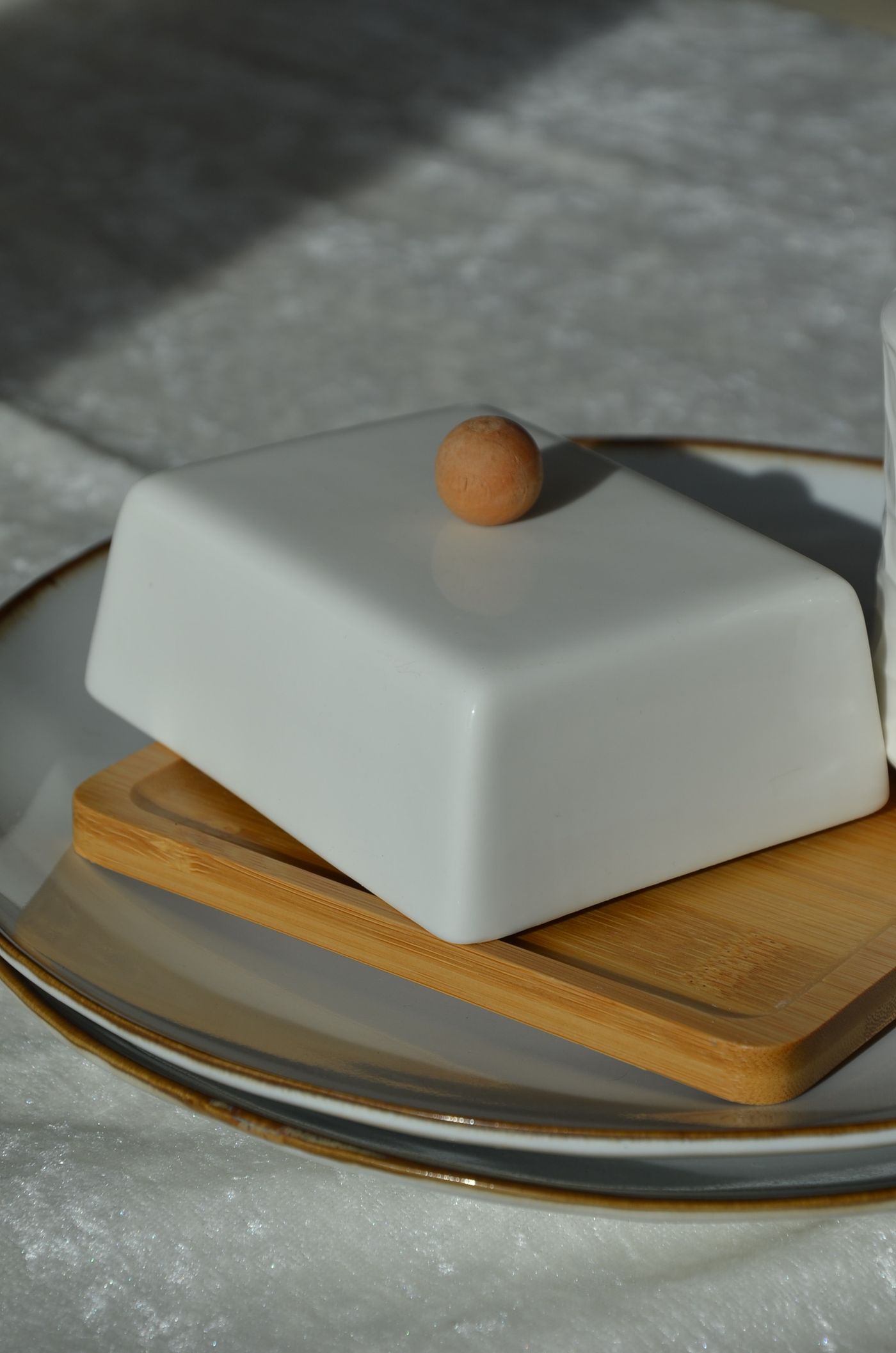
Covered butter dish: Yana / Pexels.
Freezer boundary
What material works for freezing butter?
The National Center for Home Food Preservation advises tightly wrapping high-quality butter in aluminium foil, transparent film, or freezer paper, or using a moisture-vapor-resistant container.
That guidance is about close wrapping and moisture-vapor control. A decorative butter dish with a loose lid is not the same as a freezer package.
For commercial frozen inventory, qualify the wrapper or tub at the real minimum temperature and after transport, impact, opening, and thaw cycles. Do not borrow a household best-quality time as a product release specification.
Failure-led selection
What should you check when a butter package fails?

Compliance boundary
Material names are not food-contact certificates
A butter tub should not be described as universally “FDA approved.” FDA explains that the regulatory status of a food-contact article depends on each substance that makes up the article and its authorized intended use. That can include the base polymer, coating, adhesive, colorant, antioxidant, ink-related setoff risk, label, and other components expected to migrate.
FDA’s reference tables also distinguish food types and conditions such as refrigerated storage, frozen storage, room-temperature storage, and reheating. Butter is a fatty dairy product. A document for one resin, supplier, food, or use condition does not automatically cover another.
2026 sustainability check
Is paper, foil, glass, or plastic the most sustainable choice?
There is no honest universal winner without a defined product, market, logistics route, recovery system, and comparison method. A paper wrap may need a coating or laminate. A plastic tub may improve reclosure but include a membrane, pigment, and label. A foil laminate can deliver a strong barrier yet be difficult to separate. A heavy reusable dish belongs in a different comparison from a one-time retail pack.
Start by preventing butter loss for the intended life. Then remove unnecessary material, simplify components where performance allows, and design for the collection and sorting system that exists where the pack is sold. EPA tells U.S. consumers to check what the local program accepts and notes that food contamination can prevent container recycling.
For U.S. marketing, the FTC Green Guides say recyclable claims should be qualified when suitable facilities are not available to at least 60% of consumers or communities where the product is sold. For EU projects, Regulation (EU) 2025/40 now creates packaging sustainability and labeling requirements with phased obligations. Buyers need a market-specific compliance plan rather than a generic “100% recyclable” sentence.
Qualification path
How should buyers qualify a butter container?
- Define the butter. Salted, unsalted, cultured, whipped, compound, blended, fill temperature, net weight, and shelf-life target.
- Define the route. Refrigerated or frozen storage, retail light, odors, export time, stacking, vibration, and consumer opening.
- Select a format. Fold wrap, tub, portion cup, liner and case, carton, or a combined system.
- Name every component. Substrate, grade, coating, adhesive, ink, pigment, label, membrane, lid, gasket, and secondary pack.
- Set testable limits. Dimensions, gauge or weight, folds or rim, seal, leak, peel, cold impact, sensory, light, and distribution.
- Lock change control. Record the approved drawing, suppliers, sites, tests, samples, and requalification triggers.

First-sample inspection confirms only part of the system. Filled-pack compliance, sensory, seal, shelf-life, and distribution evidence require a defined study owned by the brand and qualified partners.
Supplier brief
What should a butter-container RFQ request?
Frequently asked questions
Butter container material FAQ
What is the best material for butter containers?
For firm retail sticks and blocks, start with a qualified foil-based wrap plus carton. For soft, whipped, or compound butter, start with a sealed PP or HDPE tub. For a small home portion, use a clean covered opaque or dark-stored dish.
Is glass or plastic better for storing butter?
Neither is automatically better. Glass is easy to inspect and clean but is breakable and transparent. A qualified plastic tub is light and practical, but the exact grade, lid, temperature, reuse, and food-contact conditions matter.
Why is butter wrapped in aluminium foil?
An intact foil-based structure can give strong light, moisture, and aroma protection while folding closely around a block. Commercial wraps may be laminates with a protected food-contact side, so qualify the full construction.
Is parchment paper good for butter?
It can work for selected short or controlled routes, especially as part of an engineered coated or laminated structure. Plain parchment can transmit light and odors and allow moisture loss, so test the finished folded pack and shelf life.
What plastic is used for butter tubs?
PP and HDPE are common starting families. PP can support stiff thin-wall molded tubs, while HDPE can support tough or opaque designs. The chosen grade, geometry, seal, lid, light plan, and compliance evidence decide suitability.
Can butter be stored in stainless steel?
Yes, a clean covered stainless-steel dish is practical for a small household working portion. It blocks light but does not control temperature or make butter shelf-stable. Follow the product’s storage direction.
Does BPA-free mean a butter tub is food-safe?
No. It answers only one substance question. Food-contact suitability depends on the full construction, component identities, intended fatty food, time, temperature, use conditions, supplier, and market rules.
Is a PP butter tub recyclable?
Its real recovery depends on the complete tub, lid, membrane, label, pigment, food residue, and local collection and sorting system. Check market-specific design guidance and qualify any recyclable claim rather than relying on the resin code alone.
Turn the material question into a testable project
Discuss a PP IML butter tub around the real product and cold chain
Share the butter or spread type, fill condition, net weight, storage and distribution temperatures, membrane and lid concept, light exposure, destination market, artwork, opening experience, shelf-life objective, testing needs, and forecast volume. Honokage can discuss existing and custom PP IML formats; supplier information must still be confirmed for the selected grade, construction, food, market, and production lot.
Final recommendation
Choose the full system that protects the real butter
Use a foil-based wrapper plus carton as the default starting point for firm retail sticks and blocks. Use a PP or HDPE tub with a qualified peel seal and reclosable lid for whipped, spreadable, or compound butter. Use a covered opaque or dark-stored household dish only for the small portion you expect to use soon.
Then move beyond the material name. Confirm every component, food-contact basis, light and odor plan, fold or seal, cold performance, filling-line behavior, shelf-life result, distribution result, recovery route, and change-control term. The best material is the one that works as part of the proven complete package.
Sources and further reading
- Tetra Pak Dairy Processing Handbook: Butter — butter wrapping functions, foil, parchment, cartoning, and cold-storage context.
- Wisconsin Center for Dairy Research: Butter Packaging Q&A — odor pickup, retail-light oxidation, parchment limits, and foil-laminate considerations.
- Journal of Dairy Science: Light Transmission and Butter Oxidation — 1986 comparison of wrapper materials under defined fluorescent-light conditions.
- USDA AMS: Butter Grading Information — butter definition, commercial formats, wrappers, cartons, tubs, lids, and foil cups.
- FDA: Food Types and Conditions of Use for Food-Contact Substances — food categories and intended refrigerated, frozen, and other use conditions.
- FDA: Determining Regulatory Status of Food-Contact Material Components — component, supplier, specification, and intended-use boundaries.
- FDA: Lead-Glazed Traditional Pottery Q&A — household ceramicware selection and warning signs.
- University of Maine Cooperative Extension: Butter Storage by Product Type — 2026 household guidance for salted, unsalted, cultured, whipped, compound, and clarified products.
- National Center for Home Food Preservation: Freezing Butter — close wrapping and moisture-vapor-resistant freezer containers.
- U.S. FTC: Environmental Claims and Green Guides — qualification of recyclable and other environmental marketing claims.
- Regulation (EU) 2025/40 on Packaging and Packaging Waste — current EU packaging sustainability and labeling framework with phased requirements.
This guide provides general packaging and household-storage information. It is not legal advice, a food-contact declaration, a shelf-life release, a supplier approval, or a market-specific recycling assessment. Suitability depends on the actual butter, full package, intended use, market, and validated route.