


Quick answer
Choose an existing mold when the exact molded part already meets every non-negotiable requirement and a production-equivalent trial proves it. Choose a custom mold when geometry, function, line fit, physical differentiation or tooling control must change. Compare lifecycle cost and supply risk—not only the mold fee or first unit quote.
The lowest-risk answer is often staged. A brand may use a validated existing platform to test demand, then approve custom tooling after volume and product requirements become clearer. The reverse can also be true: a custom part that looks attractive in CAD may be a poor investment if a standard shape already performs well.
Use three gates before comparing prices
1. Fit: Does the exact part meet dimensions, capacity, closure, material, decoration, filling-line and use requirements?
2. Evidence: Do production-intent samples pass written acceptance tests across the required cavities and conditions?
3. Control: Are capacity, change notification, maintenance, ownership, data and continuity terms clear?
Existing mold vs custom mold at a glance
This comparison is intentionally qualitative. Price, lead time, output and tool life depend on the controlled design, material, cavity count, automation, production cell and validation scope.
What an existing mold really means
An existing mold is a tool that already contains cavity and core steel for a defined part. Suppliers may call it a stock, house, public, shared, standard or ready mold. Those labels do not prove that the tool is available, well maintained, approved for your resin or free for your project.
Ask for the exact tool ID, part revision, ownership status, location, cavity count, recent samples, material history, compatible machine, maintenance condition and available capacity. If the part has a lid, seal, insert, handle or mating component, identify the complete family rather than reviewing the body alone.
Still fixed
Overall shape, nominal dimensions, draft, rim, parting line, gate location, texture, wall architecture and most interfaces.
May be variable
Approved resin grades, color, artwork, IML label, printing and selected inserts or secondary operations.
Must be rechecked
Shrinkage, dimensions, ejection, closure fit, appearance, line handling, product compatibility and compliance.
Existing does not mean production-ready for your product
A tool may have produced acceptable parts with another resin, pigment, machine or lid. Material and process changes can alter shrinkage, dimensions and warpage. The exact proposed construction still needs sampling and measurement.
When an existing mold is the better choice
Existing tooling is strongest when standardization creates value rather than compromise. Use these conditions as gates. A low price cannot offset a failed seal, unsafe use or critical line-interface problem.
- The exact molded dimensions and usable capacity work. Confirm the controlled drawing, fill level, headspace, wall, weight and critical tolerances.
- The matched components work. The lid, seal, insert, handle or assembly passes its full tolerance stack and intended conditions.
- The intended construction is supported. Resin, color, IML label, printing and surface finish can run in a stable window.
- The product runs on the commercial line. It denests, fills, closes, seals, codes, inspects, packs and palletizes as required.
- The supply model is acceptable. Capacity allocation, shared-tool use, change notification, maintenance and discontinuation terms are clear.
- Demand is still uncertain. Protecting cash and learning quickly matters more than owning a unique physical shape.
Honokage’s live injection molded container catalog states that existing molds are available for faster sampling and that custom mold development is also supported. Treat each catalog platform as a candidate, not an approval.
When a custom mold is worth considering
A custom mold is justified when new geometry solves a measurable requirement or creates a durable business advantage. It is not justified simply because “custom” sounds more premium.
Required function
Capacity, closure, dispensing, tamper feature, grip, handle, stack, nest or mating interface has no suitable stock option.
Line and automation fit
The part must work with a specific filler, capper, robot, rack, tray, device or assembly process.
Recurring value
Credible volume makes better cavity output, material use, packing density or less secondary work meaningful.
Physical differentiation
Shape improves consumer use or shelf recognition in a way artwork alone cannot achieve.
Tooling control
The program needs dedicated capacity, defined change authority, documentation, spares or a planned transfer route.
Future platform
A controlled body-and-closure family supports later sizes or variants without unsafe workarounds.
Custom tooling may be premature when the requirement is moving, forecast confidence is low or the market proposition is untested. An existing mold, prototype or bridge tool can reduce uncertainty first. Do not treat bridge-tool samples as proof of future production performance when material, cooling, cavity count or surface differs.
A phased route can reduce commitment risk
The route does not have to remain fixed for the full product life. A team can launch on an existing platform, collect real filling, distribution, consumer and demand data, then move to custom tooling at a written trigger. Useful triggers include an annual-volume threshold, a retailer requirement, a repeated line loss, a closure problem, a freight penalty or a physical feature that customers clearly value.
Plan the transition before the existing route becomes a bottleneck. Define which dimensions and pack interfaces should remain compatible, whether old and new inventory can overlap, which artwork must change, and how customers will identify the revised package. Revalidate the custom version as a new controlled construction. Data from the existing product informs the design, but it does not release the new mold automatically.
The technical details that can change the answer
A mold fixes much more than the visible outline. Autodesk’s injection-molding guidance connects wall thickness, thickness variation, draft and undercuts to manufacturability. Its warpage guidance also notes that non-uniform cooling and inconsistent shrinkage can distort a part.
Wall and flow
Large thickness changes can alter filling, cooling, sink and warpage. Existing steel fixes most of the wall architecture.
Draft and ejection
Draw direction, texture, undercuts and ejection determine whether the part releases without damage.
Gate and appearance
Gate position affects flow, packing, weld-line risk and the visible gate vestige.
Cooling and shrinkage
Dimensions and flatness depend on geometry, material and process. Record conditioning time before measurement.
Cavity and machine fit
Cavity balance, platen size, shot capacity, connections, robot and downstream handling affect real output.
Décoration
Artwork cannot repair an unacceptable parting line, gate mark, curvature or label boundary.

Why IML must be reviewed before steel release
The In-Mold Decorating Association explains that in-mold labeling uses automation to place the label inside the mold before resin is injected. This means the label shape, curl, holding method, robot access, gate, venting, cooling and ejection cannot be treated as separate late-stage tasks. A stock container may accept one label boundary but not the desired wrap. A custom CAD shape may be difficult to label reliably. Review physical geometry and artwork together.
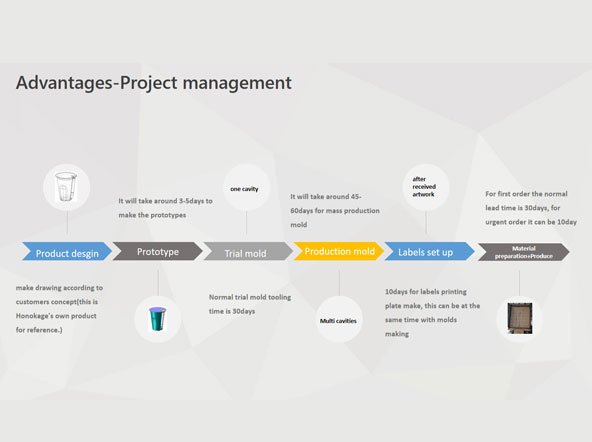
Honokage describes prototyping, mold-flow work, in-house mold making and planned tool maintenance on its IML solutions page. These are supplier capability statements; the project still needs an agreed DFM package and acceptance plan.
Compare lifecycle cost, not mold price
The existing route often has the smaller opening invoice. It is not automatically the lowest-cost route over the program life. The custom route may improve recurring performance, but those improvements are not automatic either.
Lifecycle model
Total route cost = development and tooling + qualification + accepted-part conversion + decoration and assembly + quality loss + inventory and logistics + maintenance and repair + expected disruption and change cost.
Use accepted saleable parts, not gross theoretical shots. Compare realistic resin weight, cavity output, cycle, scrap, uptime, labor, inspection, pack-out, freight and forecast utilization. Include label or print minimums and shared capacity for the existing route. Include launch yield, correction loops, spares and single-tool downtime for the custom route.
If a custom route has an additional one-time cost C and a credible recurring saving S per accepted unit, a simple screening break-even is Q = C ÷ S. This is only useful when the assumptions are comparable. Run low, expected and high volume cases. If a small change in scrap, cycle or forecast reverses the decision, collect more evidence before releasing steel.
Put mold ownership and use rights in writing
Paying a tooling charge does not automatically answer who owns, may use or can move every asset. “Private mold” is also a commercial label, not a complete legal definition. Obtain appropriate legal review for the contract and jurisdiction.
- Legal title: identify the mold base, cavity and core inserts, hot runner, controller, fixtures, gauges, robot tooling and spares.
- Right to use: define approved sites, subcontractors, products, markets and customers.
- Exclusivity: state whether another buyer may receive the same or a similar physical design.
- Change authority: control steel, texture, gate, material, cavity status, repair and process changes.
- Data access: list the CAD, mold drawings, component records, process history, maintenance logs and inspection files to be delivered.
- Maintenance: define preventive work, wear limits, storage, repairs, insurance, warranty and cost responsibility.
- Transfer: define inspection, release, transport, machine-interface checks and requalification duties.
- End of program: define storage, refurbishment, conversion, scrap and confidential-data treatment.
A tool can be buyer-owned and still fail to transfer. The receiving factory must confirm mold size, shot and clamp needs, controls, cooling, ejection, connections, automation, condition and process history. Sample and qualify the tool again on the receiving cell.

Validate either route through production evidence
An attractive first sample is not approval. The required depth depends on product risk and industry, but both routes should move through clear evidence gates.
1
Freeze requirements. Control use, material, interfaces, appearance, market, line, distribution, forecast and acceptance criteria.
2
Audit or complete DFM. For an existing tool, confirm identity, condition and fit. For custom tooling, approve the mold concept and risks.
3
Review every-cavity first samples. Record weight, dimensions, visual condition, gate and ejection issues. This is a learning gate, not commercial release.
4
Run production-intent conditions. Use the normal material, mold, machine, automation, cycle, inspection and pack-out long enough to test stability.
5
Test the complete use route. Include mating parts, product, filling or assembly line, opening, leakage, load, aging and distribution as relevant.
6
Release and control changes. Keep approved drawings, golden samples, cavity traceability, process limits and written requalification triggers.

Food and product-contact projects need another gate
A mold does not make a package “food grade.” FDA explains that food-contact substances can include packaging components such as adhesives and colorants, and that authorization relates to the intended use. For an EU market, the European Commission states that food-contact materials must meet the framework regulation, GMP rules and relevant material-specific requirements.
Lock the exact resin, additives, masterbatch, label, ink, coating, adhesive, lid or seal, food type, temperature, duration and destination market. Then obtain the appropriate compliance documents and supporting evidence. Do not use a raw-resin statement as a blanket release for the finished package.
Use one RFQ to compare both routes fairly
Ask each shortlisted supplier to quote Route A, an identified existing mold, and Route B, a custom mold, against one controlled requirement. Otherwise the price difference may come from different resin, wall, cavity, decoration, inspection, freight or validation assumptions.
Part definition
CAD or exact tool ID, drawing, dimensions, weight, capacity, CTQs, material, finish and mating parts.
Demand and line
Annual and lifetime volume, SKU mix, filling or assembly cell, downstream automation and pack-out.
Commercial basis
Itemized one-time costs, price tiers, MOQ, capacity, schedule milestones, Incoterm and exclusions.
Quality and validation
Trial rounds, all-cavity evidence, correction scope, line and distribution tests, control plan and release data.
Conformité
Exact construction, intended use, target markets, responsibilities and required declarations or testing.
Asset and continuity
Ownership, use rights, records, maintenance, spares, breakdown response, backup, transfer and end-of-life.
If your project involves IML packaging, first review the live Honokage IML container range. Then send the same product brief for an existing-platform screen and a custom DFM route.
Five buying mistakes that hide the real route risk
- Treating a close catalog size as a fit. Outside dimensions or nominal volume do not prove usable fill, lid engagement, seal geometry, stack height or line handling. Test the controlled part and all mating components.
- Assuming “private mold” proves ownership. The phrase may describe restricted commercial use while the supplier still owns the mold base, records or production rights. Rely on the asset schedule and contract.
- Approving a hand-selected sample. A polished first part can hide cavity variation, unstable process settings or manual correction. Require production-intent material, normal cycle, every-cavity identity and agreed conditioning.
- Pricing theoretical output. More cavities or a faster quoted cycle increase potential output, not guaranteed accepted parts. Include changeovers, downtime, inspection, scrap, maintenance and downstream bottlenecks.
- Using one “food-grade” document for the whole pack. The resin letter may not cover the colorant, label, ink, adhesive, lid, intended food, time, temperature or destination market. Review the exact commercial construction.
Frequently asked questions
Is an existing mold always cheaper?
It usually reduces upfront tooling work, but not always lifecycle cost. Extra material, lower cavity output, secondary work, inefficient pack-out or shared capacity can change the result.
How much does a custom injection mold cost?
There is no reliable universal price. Part size, complexity, cavity count, tool materials, hot runner, side actions, tolerances, surface, automation, trials, ownership and validation all affect the quote.
How long does a custom mold take?
There is no universal lead time. Ask for dated milestones from requirement freeze and DFM through tool design, machining, sampling, corrections, production-intent run, testing and release.
Does paying for a mold mean I own it?
Not necessarily. The written agreement should identify the assets, title milestone, exclusivity, use and change rights, data, maintenance, inspection, transfer and end-of-program treatment.
Can an existing mold be modified?
Sometimes. Inserts, logo plates, local machining, texture, gates or vents may be changeable. Review ownership, irreversibility, cooling and cavity-balance risk, then trial and requalify the revised tool.
Does a custom mold always reduce unit price?
No. It may improve weight, output, automation or packing, but complexity, launch yield, downtime and low utilization may offset the gain. Model accepted output rather than ideal shots.
Can a custom mold move to another factory?
Possibly, when ownership and release terms permit and the receiving operation is compatible. Audit the tool, machine, controls, cooling, ejection, automation, drawings and condition, then sample and requalify it.
Need an existing-platform screen and custom-mold review?
Send the target part or available platform, material, annual volume, critical dimensions, mating components, product-contact conditions, decoration, line constraints, test plan, target market and desired tooling rights.
Sources and scope notes
This guide covers general thermoplastic injection-molding decisions. Medical, automotive, child-resistant, pressure, electrical, structural and other safety-critical parts need additional industry-specific design controls and qualification. Project cost, timing, tool life and output require a controlled RFQ.
- Autodesk Fusion: Plastic Rules — material, thickness, thickness variation, draft and manufacturability checks.
- Autodesk Moldflow: Warpage Problems — cooling, shrinkage, process and material causes of warpage.
- In-Mold Decorating Association: In-Mold 101 — label creation, automation, molding and IML applications.
- FDA: Food Packaging and Food-Contact Substances — components, authorization and intended-use safety assessment.
- European Commission: Food Contact Materials — EU framework, GMP and material-specific requirements.
- Honokage: Injection Molded Plastic Containers — current supplier catalog and existing/custom route statement.
- Honokage: IML Solutions — supplier statements on development, prototyping, mold-flow work, mold making and production support.