


Fast U.S. butter conversion
1 cup of butter = 2 standard U.S. sticks
The complete conversion is 2 sticks = 1 U.S. cup = 16 tablespoons = 48 teaspoons = 8 ounces by weight = about 227 grams. This answer assumes each stick is the standard U.S. 4-ounce, quarter-pound size.
How many sticks of butter is 1 cup?
Two sticks. If the package contains standard U.S. sticks, open two complete sticks for a recipe that calls for one cup. You do not need to press the butter into a measuring cup.
1 tasse
2 bâtons
16 tbsp · 227 g
1 bâton
1/2 tasse
8 tbsp · 113 g
1 pound
4 bâtons
2 cups · 454 g
Check before counting: the word stick describes a package format, not a universal unit. A half-stick, metric block, roll, whipped product or spread tub may have a different weight.
Butter cup-to-stick conversion chart
Use this chart for common recipe amounts. All values assume a standard U.S. 4-ounce stick. Gram figures are rounded to useful kitchen numbers, so a scale that reads to the nearest gram is accurate enough for most home baking.
| Butter amount | U.S. sticks | Spoons and grams |
|---|---|---|
| 1/16 cup | 1/8 stick | 1 tbsp · 14 g |
| 1/8 cup | bâtonnet de 1/4 | 2 tbsp · 28 g |
| 1/4 tasse | 1/2 bâtonnet | 4 tbsp · 57 g |
| 1/3 cup | 2/3 stick | 5 tbsp + 1 tsp · 76 g |
| 1/2 tasse | 1 bâton | 8 tbsp · 113 g |
| 2/3 tasse | 1 1/3 sticks | 10 tbsp + 2 tsp · 151 g |
| 3/4 tasse | 1 1/2 sticks | 12 tbsp · 170 g |
| 1 tasse | 2 bâtons | 16 tbsp · 227 g |
| 1 tasse et demie | 3 bâtons | 24 tbsp · 340 g |
| 2 tasses | 4 bâtons | 32 tbsp · 454 g |
Reference check: Land O’Lakes publishes 1 cup as 2 full sticks, 16 tablespoons, 8 ounces and 227 grams. Exact pound-based math gives 226.796 grams per cup; 227 grams is the normal kitchen rounding.
Four simple formulas
These formulas cover nearly every U.S. recipe. Use decimal numbers for the calculation, then change the answer back to a familiar fraction if needed.
Cups to sticks
sticks = cups × 2
1.25 cups = 2.5 sticks.
Sticks to cups
cups = sticks ÷ 2
5 sticks = 2.5 cups.
Cups to spoons
tbsp = cups × 16
3/4 cup = 12 tablespoons.
Cups to grams
grams ≈ cups × 226.8
1.5 cups ≈ 340 g.
Three reliable ways to measure 1 cup of butter
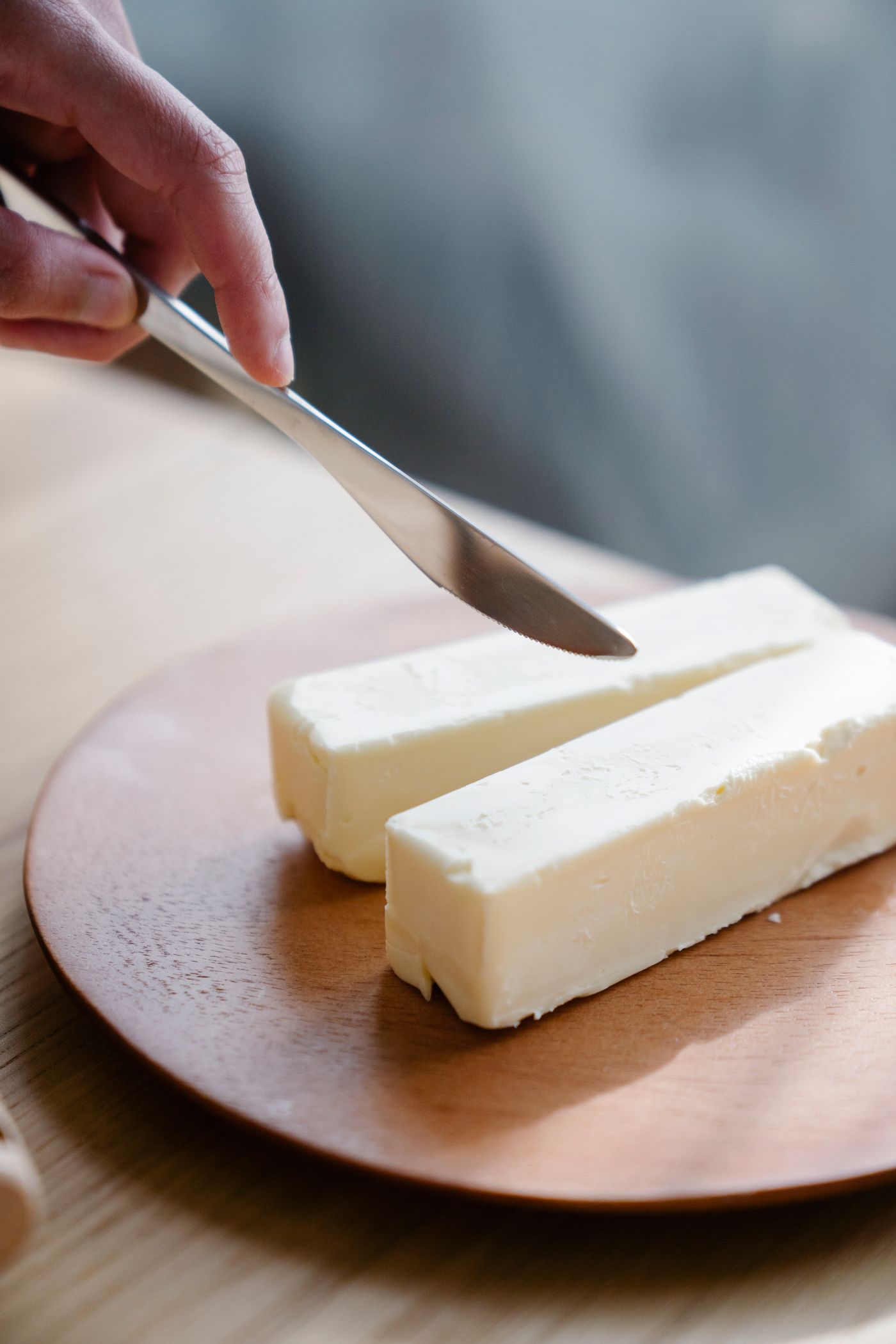
Count two full sticks.
This is the fastest method when each wrapper says 4 oz or about 113 g. Half-sticks do not count as full sticks.
Weigh 227 grams.
This is the easiest method for a metric block, loose pieces or a partially used package. Place a bowl on the scale, tare it, and add butter.
Cut 16 tablespoon marks.
Many U.S. wrappers show eight tablespoon marks per stick. Use sixteen marks in total, but treat the printing as a kitchen guide rather than a calibrated production measure.
What if you only have scraps? A scale is best. Add the pieces until the display reads 227 g. Water displacement can work with very cold, solid butter, but it is messy, it does not work well with softened butter, and it is less direct than weighing.
Wrapper marks or a scale: which should you use?
Both methods can work, but they solve different problems. Wrapper marks are fast for an everyday U.S. recipe. A digital scale is easier when the package is unfamiliar, the butter is already cut, or the recipe needs a precise fraction.
Use wrapper marks when
- the label confirms a 4-ounce U.S. stick;
- you need a simple amount such as 1/4 or 1/2 cup;
- the stick is cold enough to hold its shape; and
- small kitchen-level rounding will not change the result.
Use a scale when
- the butter comes in a 250 g or 500 g block;
- you have scraps, an opened pack or an unusual shape;
- the recipe needs 1/3, 2/3 or another awkward fraction; or
- you are scaling a formula or comparing test batches.
For the scale method, put the mixing bowl on the platform and press tare so the display returns to zero. Add butter until it reads the target mass. If you go over, remove a small piece. This avoids packing gaps, keeps another measuring cup clean and makes metric recipes much easier to follow.
Do not confuse ounces with fluid ounces
This is the most important unit trap. Ounces (oz) measure mass or weight. Fluid ounces (fl oz) measure volume. A package marked 8 oz contains half a pound of butter. A liquid measuring cup marked 8 fl oz holds one U.S. cup of volume.
8 oz butter
This is mass. It equals two standard sticks, one-half pound or about 227 g.
8 U.S. fl oz
This is volume. It equals one U.S. customary cup, about 236.6 mL.
Same number, different idea
Butter happens to use the number eight in both common statements. That does not make oz and fl oz interchangeable.
NIST lists the U.S. kitchen cup at about 240 mL for practical cooking and one ounce by weight at about 28 g. Ingredient density determines how much a cup weighs, so never apply butter’s 227 g-per-cup value to flour, sugar, milk or another food.
Cold, softened, melted and browned butter
The starting amount stays the same when butter changes temperature: two intact sticks still began as 227 g. The recipe result may change, however, because solid fat, soft fat and liquid fat behave differently.
Cold butter
Count two sticks or weigh 227 g. Keep it cold if the recipe depends on flakes, layers or pieces of solid fat.
Softened butter
Measure before softening. Properly softened butter bends under pressure but should not be greasy or partly liquid when a recipe calls for creaming.
Melted butter
For “1 cup butter, melted,” start with two sticks and then melt. Scrape the pan so the full measured amount reaches the bowl.
One cup melted butter
This wording may tell you to melt first and then measure the liquid volume. Follow the recipe method or its gram quantity when the distinction matters.
Browned butter
Water evaporates during browning, so the final mass is lower. If a recipe says to brown one cup of butter, begin with two sticks unless it gives a target final yield.
Microwave warning
Microwaves can create a melted center while the outside still looks solid. Use short intervals only when melted butter is actually required.
Using metric blocks and non-U.S. recipes
A standard U.S. stick is a regional packaging convention. USDA describes quarter-pound sticks among common U.S. butter formats, but stores in many other countries sell 250 g or 500 g blocks instead. Do not estimate from the shape. Weigh the amount the recipe needs.
250 g block
about 2.20 sticks
It is about 1.10 U.S. cups. Remove about 23 g to get one U.S. cup of butter.
454 g block
4 bâtons
This equals one U.S. pound or approximately two U.S. cups of butter.
500 g block
about 4.41 sticks
It is about 2.20 U.S. cups. Weigh 227 g when the recipe needs one cup.
U.S. cup versus a 250 mL metric cup
Health Canada distinguishes the U.S. cup, 236.6 mL, from the 250 mL metric household cup. The metric cup is roughly 5.7% larger. This difference can matter in baking, especially when a recipe mixes volume measures with precise ratios.
Best solution: identify the recipe’s country or publisher, then use its stated grams. If it is a U.S. recipe with no gram value, treat one cup of butter as about 227 g.
What to do when the recipe source is unclear
Online recipes are read around the world, and a page may not say whether its cup is U.S. customary or metric. Do not let that stop the recipe. Use this short check before you measure.
- Look for grams beside the ingredient. A listed mass is the clearest instruction. Use it even if your package has wrapper marks.
- Check the recipe’s location and language. U.S. publishers commonly use a 236.6 mL customary cup. Australian, Canadian and other metric recipes may use a 250 mL cup, but do not assume without checking the site.
- Read the rest of the ingredient list. Fahrenheit temperatures, pounds and U.S. fluid ounces suggest a U.S. system. Celsius, liters and grams suggest a metric system.
- Check the method wording. It may tell you to cube cold butter, cream softened butter, or melt it before mixing. Correct quantity cannot repair the wrong physical state.
- When still uncertain, use 227 g and note the choice. This is the conventional mass for one U.S. cup of butter. For a sensitive pastry or a commercial batch, ask the author or run a small controlled test before scaling.
A useful clue is not proof. Country, spelling and oven temperature help identify the unit system, but only the publisher’s declared measurements or an approved formula settle the question.
Do different butter products use the same conversion?
Salted and unsalted butter: yes, if each package has the same net weight. A 4-ounce salted stick and a 4-ounce unsalted stick are both one standard stick. Salt affects flavor and formulation, not the unit conversion.
European-style or higher-fat butter: the mass conversion remains the same for a 4-ounce portion, but recipe behavior may differ. Fat level, moisture, plasticity and flavor can affect pastry layers, spread, tenderness and emulsions. USDA defines U.S. butter as containing at least 80% milkfat by weight; equal mass does not promise identical performance.
Elgin and Western sticks: traditional U.S. stick shapes can differ by region. A long, narrow stick and a shorter, wider stick can both weigh 4 ounces. Count the declared weight, not the geometry.
Whipped butter, margarine, tub spreads and ghee: do not assume that one cup works as a one-for-one baking substitute. Whipped butter contains air; spreads can contain more water; ghee has much of the water and nonfat solids removed. Convert the declared mass first, then check whether the product’s fat, water, salt and melting behavior fit the recipe.
Common recipe examples
Recipe needs 1 1/4 cups
Multiply 1.25 by 2. You need 2.5 sticks, or two full sticks plus half a stick. By weight, use about 284 g.
Recipe needs 2/3 cup
Use 1 1/3 sticks, 10 tablespoons plus 2 teaspoons, or about 151 g. A scale is easier than estimating one-third of a stick.
You have 3 sticks
Divide 3 by 2. You have 1.5 cups, 24 tablespoons, 12 ounces by weight or about 340 g.
Doubling a 3/4-cup recipe
Three-quarters cup is 1.5 sticks. Double it to 3 sticks, which equals 1.5 cups or about 340 g.
Halving a 1-cup recipe
Half of one cup is one stick, 8 tablespoons, 4 ounces or about 113 g.
Using a 250 g block
Do not cut off an estimated nine-tenths. Put a bowl on a scale and weigh 227 g for one U.S. cup.
How to scale the conversion for a bakery
Sticks and cups are convenient at home, but grams and kilograms are safer for production. Convert the master formula once, choose one documented factor, and avoid changing between 113 g and 113.4 g in the same batch calculation.
Worked batch example
1.25 cups per batch × 18 batches = 22.5 cups
Multiply 22.5 cups by 2 to get 45 sticks. For production, multiply by 226.8 g per cup: the target is about 5.103 kg of butter. Round only according to the approved scale resolution and formula-control procedure.
- Confirm that the original recipe means a U.S. cup and standard quarter-pound sticks.
- Convert the full formula to grams before multiplying the batch count.
- Keep one factor through the calculation and round once at the final controlled step.
- Run a controlled trial and check yield, dough or batter behavior, bake result and sensory quality.
- Store the approved gram quantity in the master formula; retain cups or sticks only as secondary operator guidance.
Seven mistakes that cause wrong butter amounts
Counting a half-stick as a full stick.
Read the net weight. A full standard U.S. stick is 4 oz, not 2 oz.
Assuming every bar is one stick.
A metric block or regional pack may be larger or smaller. Shape is not a unit.
Using fluid ounces for package weight.
Package oz is mass. Measuring-cup fl oz is volume.
Using half a 250 g block as one stick.
Half is 125 g. One U.S. stick is about 113 g.
Ignoring recipe wording.
“Butter, melted” and “melted butter” can describe a different measuring sequence.
Substituting a whipped or spread product by volume.
Air, water and fat levels can change both the amount and the recipe result.
Rounding at every step.
In a large batch, repeated rounding can create a real formula error. Calculate first and round once.

For butter and spread brands: conversion is not a pack specification
A cook asks, “How many sticks of butter is 1 cup?” A packaging team needs a different set of answers. Two sticks or 227 g describes product quantity. It does not define tub capacity, brimful volume, usable fill volume, headspace, lid fit, seal performance or the space available for artwork.
For a butter, margarine or dairy-spread tub, start with the actual formula and filling process. Fat-rich foods and dairy products must be matched to the food-contact construction and intended use conditions. FDA’s food-contact framework separates food types and conditions such as room-temperature, refrigerated and frozen storage; the approved material status also depends on each component and its intended use.
Define the product
Butter, margarine, whipped spread and blended products can differ in density, fat, water, salt, temperature and filling behavior.
Define net content
State the target fill in grams or ounces and the allowed process tolerance. Do not infer net mass from a nominal milliliter capacity.
Define the use
Record fill temperature, cooling, storage, distribution, opening, reclosing, spooning and any freezer or reheating requirement.
Honokage’s live butter container range shows multiple IML tub formats for dairy products and spreads. Treat every published value as a starting reference and confirm the selected article, lid, artwork, material declaration and performance requirements for the real project.

What to include in a useful tub-packaging brief
- Product and fill: recipe type, density if known, target net weight, fill temperature and line speed.
- Container target: usable volume, headspace, shape, dimensions, lid style and opening experience.
- Cold chain: cooling method, storage temperature, freeze-thaw exposure and distribution duration.
- Line interface: denesting, gripping, filling, closing, coding, checkweighing and secondary packing.
- Artwork: IML coverage, colors, legal copy, barcode, date-code area and approved master files.
- Evidence: declaration needs, migration basis, sample plan and product-specific closure, leak, stack and transport checks.
A published 250 g margarine container may be a useful format reference, but “250 g” in a product name is not a universal density conversion. Verify the real fill and required headspace with the actual spread.

Verify the package with the real product
Capacity data and a clean first sample are useful, but they are not the whole qualification. Confirm performance after filling, cooling, storage, distribution and repeated consumer opening.
- Check container and lid dimensions against the approved drawing and filling line.
- Measure actual net content separately from nominal container capacity.
- Test lid engagement, leak resistance, stacking and reclosing at the intended temperature.
- Review IML placement, legibility, barcode quality and date-code area.
- Document the sample, lot, conditions, method, acceptance criteria and result.
Honokage publishes a quality testing overview. Use it to start the conversation, then agree on the product-specific test plan and acceptance criteria before production.
Frequently asked questions
Is 1 cup of butter really 2 sticks?
Yes, when both are standard U.S. 4-ounce sticks. Together they weigh 8 ounces, one-half pound or about 227 grams.
How many tablespoons are in 1 cup of butter?
There are 16 U.S. tablespoons in one cup. Each standard stick has 8 tablespoons, so two sticks provide 16.
How many grams are in 1 cup of butter?
Use about 227 grams for one U.S. cup of butter. The exact quarter-pound calculation is 226.796 grams, but 227 g is the practical kitchen value.
Is one 250 g block equal to one cup?
No. A 250 g block is about 1.10 U.S. cups, or about 2.20 standard sticks. Weigh 227 g and save the remaining 23 g.
Does a melted stick still equal half a cup?
It began as the same 113 g amount, but the recipe wording controls whether you should measure before or after melting. For “butter, melted,” measure first and melt second.
Can I use a cup measure instead of counting sticks?
You can, but counting intact sticks or weighing 227 g is cleaner and usually more accurate. Pressing softened butter into a cup can leave gaps or trap excess.
Are salted and unsalted butter measured the same?
Yes, when the package weights match. The recipe may need a salt adjustment, but the stick, cup and gram conversions do not change.
Butter and spread packaging projects
Bring the fill, line and market details
If you are sourcing an IML tub for butter, margarine or another refrigerated spread, send the product type, target net weight, desired format, fill conditions, annual demand, artwork status, destination market and required tests. Honokage can review available formats and project-specific requirements; final suitability should be confirmed through agreed documentation and testing.
Final answer to remember
One U.S. cup of butter equals two standard U.S. sticks. It also equals 16 tablespoons, 48 teaspoons, 8 ounces by weight, one-half pound or approximately 227 grams.
When the package is not a U.S. 4-ounce stick, skip the guesswork and weigh 227 g. For melted, browned or substituted fats, follow the recipe’s method as well as its quantity.
Sources and measurement notes
Conversion values were checked against the Land O’Lakes butter conversion table, NIST Metric Kitchen equivalencies et Health Canada’s household-measure table.
Butter identity and U.S. package-format context were checked against USDA Agricultural Marketing Service butter information.
Food-packaging statements were framed using FDA’s food types and conditions of use et food-contact component status guidance. Sources support general education; a recipe, product specification, food-contact declaration or market-specific legal review controls the final use.