



Quick answer
How heavy is a 5-gallon bucket?
Published current examples show an empty plastic 5-gallon pail body at about 1.67–2.10 lb, a specialty plastic pail-and-lid system at 3.10 lb, and a closed-top steel example at 4.46 lb. These are product examples, not a universal market range. The exact lid, handle, wall, gasket, liner and duty rating change the tare.
For water, use 41.7 lb as the contents-only benchmark at exactly five U.S. gallons, then add the complete empty package. For anything else, use the real product density and actual fill volume. A scale gives the final answer.
Fast formula: gross weight = complete empty tare + (actual fill volume × product density). The result estimates weight; it does not prove the handle, stack, shipment or person is suitable for that load.
Use the right number
Tare, net contents and gross weight are different
The phrase “bucket weight” can mean three different values. Mixing them causes most bad lifting, freight and storage estimates.
If a catalog lists only the body weight, do not treat it as finished-package tare. Weigh the same configuration that will actually be filled, closed, stored or shipped.

The named capacity, actual fill and finished weight answer different questions. Image: Honokage.
Capacity is not a fill instruction
Does a 5-gallon bucket hold exactly five gallons to the rim?
Not necessarily. Five gallons is often a nominal capacity class. A current 90-mil HDPE pail example lists 5.4 gallons at overflow, while a clear PP example lists 5.2 gallons. Those values belong only to those designs.
A working fill can be lower than the rim because the package may need headspace for lid application, movement, foaming, thermal expansion, mixing or a process specification. Filling to the visible top can add unexpected weight and increase spill or closure problems.
Calculation method
How do you calculate a full bucket?
For a liquid whose density is listed in pounds per U.S. gallon:
Gross weight (lb) = tare (lb) + actual gallons × density (lb/gal)
If a current safety data sheet or technical data sheet gives specific gravity instead, a useful planning equation is:
Gross weight (lb) ≈ tare + gallons × specific gravity × 8.33
Use the density at a relevant temperature and formulation. Paint, coatings, adhesives and chemical products can change by base, pigment, solids, batch and temperature. For bulk solids, moisture and compaction matter. Do not use a generic online category value when the result controls lifting, shipping or equipment.
Metric method: gross mass (kg) = tare (kg) + actual liters × density (kg/L). Five U.S. gallons is about 18.927 L. When inputs are uncertain, weigh a representative finished unit.
Planning comparison
How heavy are water, paint, sand and concrete?
The figures below are contents-only planning values at exactly five U.S. gallons. Add the complete tare. They are not universal product specifications, bucket ratings or safe-lifting limits.
Five U.S. gallons is about 0.6684 ft³. Sand and concrete figures use that volume and the cited government density ranges.

Equal volume does not mean equal weight. Product condition belongs in every estimate. Image: Honokage.
Empty package examples
How much does an empty 5-gallon bucket weigh?
There is no universal tare. Current published product examples show why the body, closure and performance design must be named.
These examples were checked in August 2026. They do not describe Honokage products and should not become a universal RFQ range. Supplier pages can change; confirm the current document for the exact SKU.
What changes empty weight?
Why can two 5-gallon buckets have different tare weights?
Capacity tells you how much space a package is designed to provide. It does not define how much material is in the package. A thin general-purpose pail, a reinforced shipping pail and a closed-top steel system can all be called five gallons while using very different constructions.
These details can change empty weight and performance:
Do not choose only by the lightest tare. A few ounces saved are not useful if the handle, lid, stack or compatibility fails in the real route. Compare the complete system against the product and test plan.
From one bucket to a shipment
How does bucket weight affect a case or pallet?
The finished unit weight is the starting point for a larger load calculation. Multiply the measured gross weight by the number of pails, then add any carton, divider, stretch film, slip sheet and pallet tare. Keep the result separate from the supplier’s stack test or pallet pattern; weight arithmetic alone does not prove stack stability.
Example: if one finished pail weighs 53.7 lb, 36 pails contain 1,933.2 lb before the pallet and other packaging are added. If the empty package estimate is low by only 0.5 lb per unit, the 36-unit load is low by another 18 lb. That difference can affect freight class inputs, lift-equipment planning, rack checks and warehouse procedures.
Use the heaviest credible product condition, not only the average batch. Record whether the stated gross includes the closure, accessories and outer pack. Then verify a production-representative pallet for compression, movement, temperature, vibration and handling conditions.
Worked liquid examples
What does the formula look like in practice?
Water: USGS uses 8.34 lb per U.S. gallon as a practical reference. Five gallons is 41.7 lb. Add a measured 2.7 lb configured pail and lid, and the gross weight is 44.4 lb.
Paint: one current BEHR PRO i300 semi-gloss technical data sheet lists 10.2 lb per gallon. At an assumed five-gallon actual fill, that specific formula contains 51.0 lb of paint. Add 2.7 lb of packaging and the example gross is 53.7 lb.
Liquid with SG 1.18: at a 4.75-gallon working fill and 2.7 lb tare, gross weight is about 49.4 lb: 2.7 + (4.75 × 1.18 × 8.33).
Paint and chemical density values are formula-specific. Use the current SDS, TDS, batch data or direct scale measurement. Never assume all five-gallon paint pails weigh 54 lb.
Manual handling boundary
Is a full 5-gallon bucket safe for one person to lift?
Weight alone cannot answer that question. OSHA explains that the Revised NIOSH Lifting Equation starts with a 51 lb load constant only under ideal two-handed conditions. It adjusts for reach, height, travel, twisting, frequency, duration and grip quality.
The equation is not designed for one-handed lifting, carrying, walking, unstable loads or restricted spaces. A bucket carried by one wire handle can combine several of those limits. A roughly 44 lb water pail may still be unsuitable on stairs, over distance, with poor footing, during repeated work or for a particular person.
This guide is not an individual medical clearance or workplace ergonomic assessment. Employers should evaluate the real task, worker, route, frequency and controls.
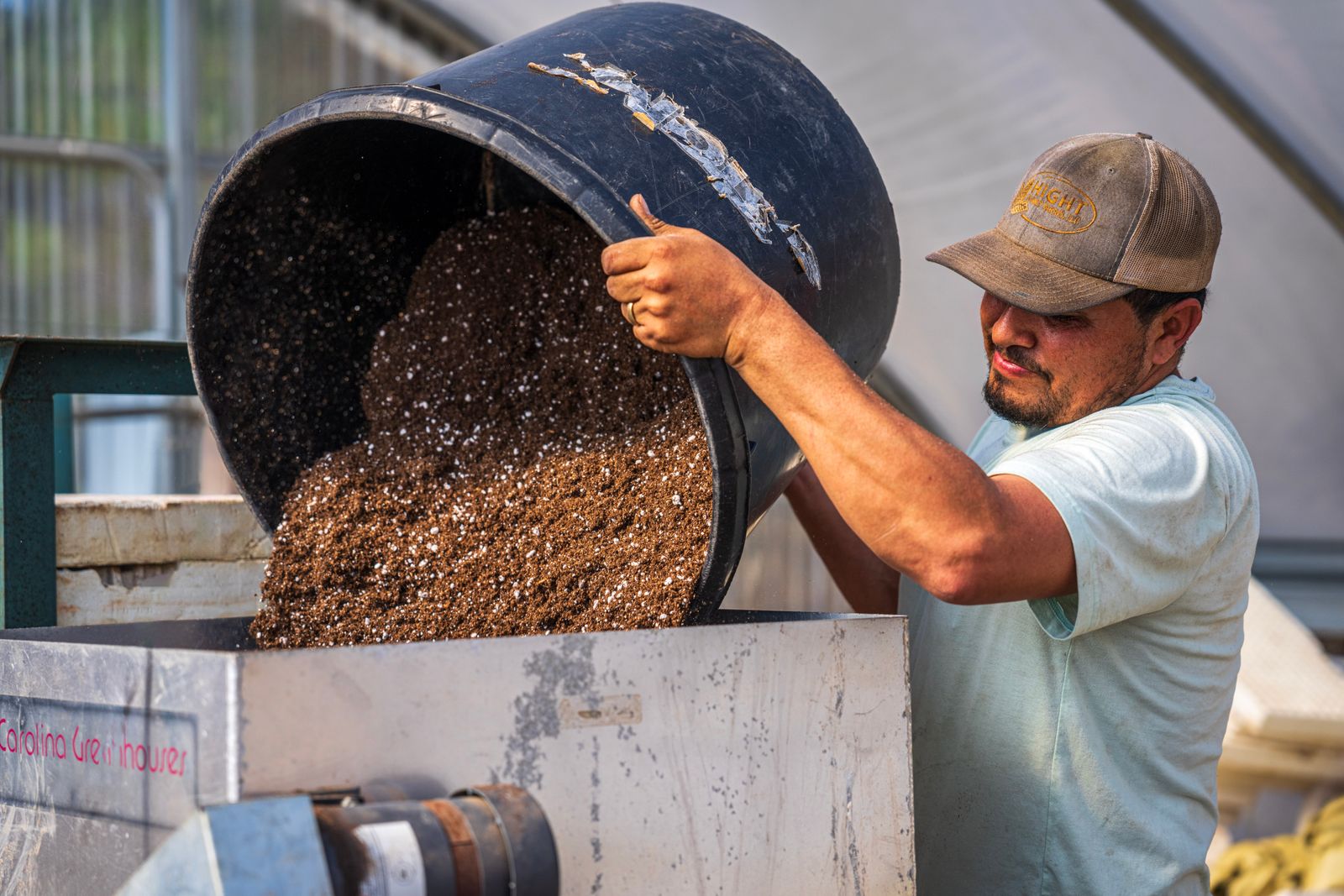
Moisture, compaction, route and carrying method can matter as much as the bucket size. Scene: Mark Stebnicki / Pexels.
Weight is only one approval question
Can the same bucket hold food, water, fuel or hazardous materials?
No generic 5-gallon bucket is suitable for every content. Capacity and weight calculations do not establish product compatibility, food-contact status, closure integrity or transport qualification.

Commercial pail selection must match the actual product, fill, closure, gross load and market. Image: Honokage.
Household safety
Never leave a water-filled bucket accessible to a young child
CPSC warns that large buckets, especially the five-gallon size, present a drowning hazard to small children. Their tall sides and stability can make it hard for a top-heavy infant or toddler to escape after falling headfirst.
Do not rely on the water being shallow. Keep children away from buckets containing water or other liquid, maintain close supervision and empty the bucket promptly when practical. Follow the warning label on the actual product.
A field method that works
Measure before you lift, ship or quote
1
2
3
4
5
6
For packaging buyers
What belongs in a 5-gallon pail RFQ?
A request for only a “5-gallon bucket” leaves too much undefined. Give the supplier enough information to calculate the heaviest credible finished load and choose a testable package system.

A finished-pack trial should use the actual product, closure, gross load and route. Image: Honokage.
Avoid these errors
Common mistakes that create bad weight estimates
Frequently asked questions
5-gallon bucket weight FAQ
How much does an empty 5-gallon bucket weigh?
It varies. Current examples include 1.67 lb for a clear PP pail body, 2.10 lb for a 90-mil HDPE body, 3.10 lb for a specialty plastic pail-and-lid system and 4.46 lb for a closed-top steel pail. Measure your complete configuration.
Wie viel wiegt ein 5-Gallonen-Eimer Wasser?
Five U.S. gallons of water weighs about 41.7 lb. After adding a plastic pail and lid, many practical examples land around 44–45 lb gross. Use a scale for the exact finished unit.
How much does a 5-gallon bucket of paint weigh?
Check the exact paint data sheet. One BEHR formula lists 10.2 lb/gal, producing 51 lb of contents at five gallons and about 53.7 lb with an example 2.7 lb package. Other paint formulas vary.
How much does a 5-gallon bucket of sand weigh?
A USACE dry-sand range produces about 67–87 lb of contents at exactly five gallons, before the bucket. Moisture and packing change the result, so weigh the real load.
How much does five gallons of concrete weigh?
Using FHWA’s typical 145–150 lb/ft³ normal-weight concrete range gives about 97–100 lb of contents. Mix and air vary. This is not a manual-lifting recommendation.
Is a 5-gallon bucket exactly five gallons at the top?
Not necessarily. The nominal size can have a higher overflow capacity. Use the supplier drawing and actual working-fill specification rather than the visible rim.
Can one person carry a full water bucket?
The roughly 44–45 lb gross weight is not enough to decide. One-handed carrying, stairs, distance, repetition, slosh, reach, grip and the person all affect risk. Reduce the fill or use handling equipment when needed.
Does the lid count in shipping weight?
Yes. Include the lid, handle, gasket, liner, label, pump and other accessories in tare. Freight gross weight uses the completed configured package plus contents and any stated outer packaging.
For commercial pail projects
Specify the product and gross load before selecting the bucket
Share the product density range, actual fill, maximum gross weight, filling temperature, closure and tamper-evidence needs, food or chemical contact, pallet pattern, storage conditions, transport route, destination market and validation plan. Honokage can discuss suitable plastic bucket directions, but final claims and limits require evidence for the exact selected system.
Final recommendation
Use a formula for planning and a scale for the real answer
Remember 41.7 lb for five U.S. gallons of water, then add the complete pail and lid. That creates a useful mid-40-lb benchmark for many common water-filled plastic systems.
For paint, sand, soil, concrete, food or chemicals, use actual density and fill condition or weigh the finished bucket. Keep capacity, structural package limits, stack performance, transport qualification, food contact and human handling as separate decisions. “Five gallon” describes a nominal volume, not a universal weight or safe carry.
Sources and further reading
- NIST Guide to the SI conversion factors — U.S. gallon-to-liter conversion.
- U.S. Geological Survey: A Million Gallons of Water — practical 8.34 lb/gal water reference.
- U.S. Army Corps of Engineers: Flood Emergency Handbook — dry-sand bulk-weight range and moisture/packing limitations.
- Federal Highway Administration: normal-weight concrete context — typical 145–150 lb/ft³ density.
- BEHR PRO i300 semi-gloss technical data sheet — product-specific 10.2 lb/gal paint example.
- OSHA Technical Manual: ergonomics and lifting — 51 lb load constant, ideal conditions and excluded tasks.
- OSHA 1926.152: Flammable liquids — U.S. construction-scope container requirements.
- PHMSA Interpretation 26-0037 — UN specification packaging approval and design-qualification boundary.
- FDA: determining food-contact material status — component, specification, supplier and intended-use context.
- CDC: Safe Water Storage — container opening, lid, cleaning and prior-use guidance.
- CPSC: Large Buckets Are Drowning Hazards for Young Children — household liquid-bucket warning.
- Uline clear PP pail, 90-mil HDPE pail, specialty plastic pail system Und closed-top steel pail — configuration-specific tare examples checked August 2026.
Safety limitation: calculations are planning estimates, not a pail certification, individual lifting assessment, hazardous-material instruction, food-contact declaration or shipping authorization. Verify the exact pail, lid, contents, closure procedure, route and current requirements.