


Quick answer
How do you determine if ice cream has gone bad? Start with facts that can change the decision: a known thawing event, a power outage, a leaking or broken package, visible mold, an unmistakably abnormal odor or a matching recall.
Ice crystals, graininess, surface dryness, freezer burn, flavor fade and a past quality date can make a product disappointing. They do not measure its peak temperature, warm holding time or microbiological condition. A normal appearance is also not a safety certificate.
Decision order: check temperature history first, package integrity and recall status second, clear spoilage third, and texture or flavor quality last. Do not taste suspect ice cream to decide whether it is safe.
“Gone bad” can mean three different things
Signs and actions
What are the signs that ice cream has gone bad?
A useful inspection asks what each observation can support and what it cannot prove. Several related clues are more meaningful than one isolated crystal, but a documented temperature incident outranks them all.
This table is a screening aid, not a laboratory result or product-release specification. Local authorities, manufacturers and food businesses may have more specific instructions.
Evidence hierarchy
How should you determine whether ice cream is still good?
The strongest information is not the most dramatic-looking clue. A freezer reading, outage timeline, observed melting, delivery record or recall notice can establish an event. Crystals and stale flavor cannot. Use the hierarchy below so a weak sensory impression never overrides a known failure.
Never clear a suspect tub with one spoonful. Pathogenic contamination, allergen errors and prior temperature abuse may not create a warning taste or smell.
Quality science
Do ice crystals or freezer burn mean ice cream is unsafe?
Usually not by themselves. Ice cream is a frozen foam containing many small ice crystals, an unfrozen sugar-and-solids phase, air cells and a fat-protein network. When temperature rises, some small crystals melt. During cooling, mobile water freezes onto surviving crystals, so fewer crystals become larger. The result is an icy, gritty or sandy scoop.
This process, called recrystallization, can be accelerated by repeated temperature fluctuations, a warm freezer, slow hardening or long storage. It explains a texture defect; it does not measure bacteria. A smooth scoop cannot prove safety either because the product may have experienced an event that left little visible evidence.
Freezer burn has a different mechanism. Surface moisture is lost during frozen storage, often when the closure is imperfect or air exposure continues for a long time. The surface may look dry, pale, tough or shrunken. FDA treats freezer burn as a quality issue rather than a food-safety diagnosis.
Recrystallization
Larger crystals, graininess and lost creaminess. A clue to quality loss or temperature instability.
Freezer burn
Surface dehydration and air exposure. Mainly a quality defect when the food stayed frozen.
Oxidation and odor pickup
Stale, cardboard-like or foreign flavors that may reveal long storage or poor closure.

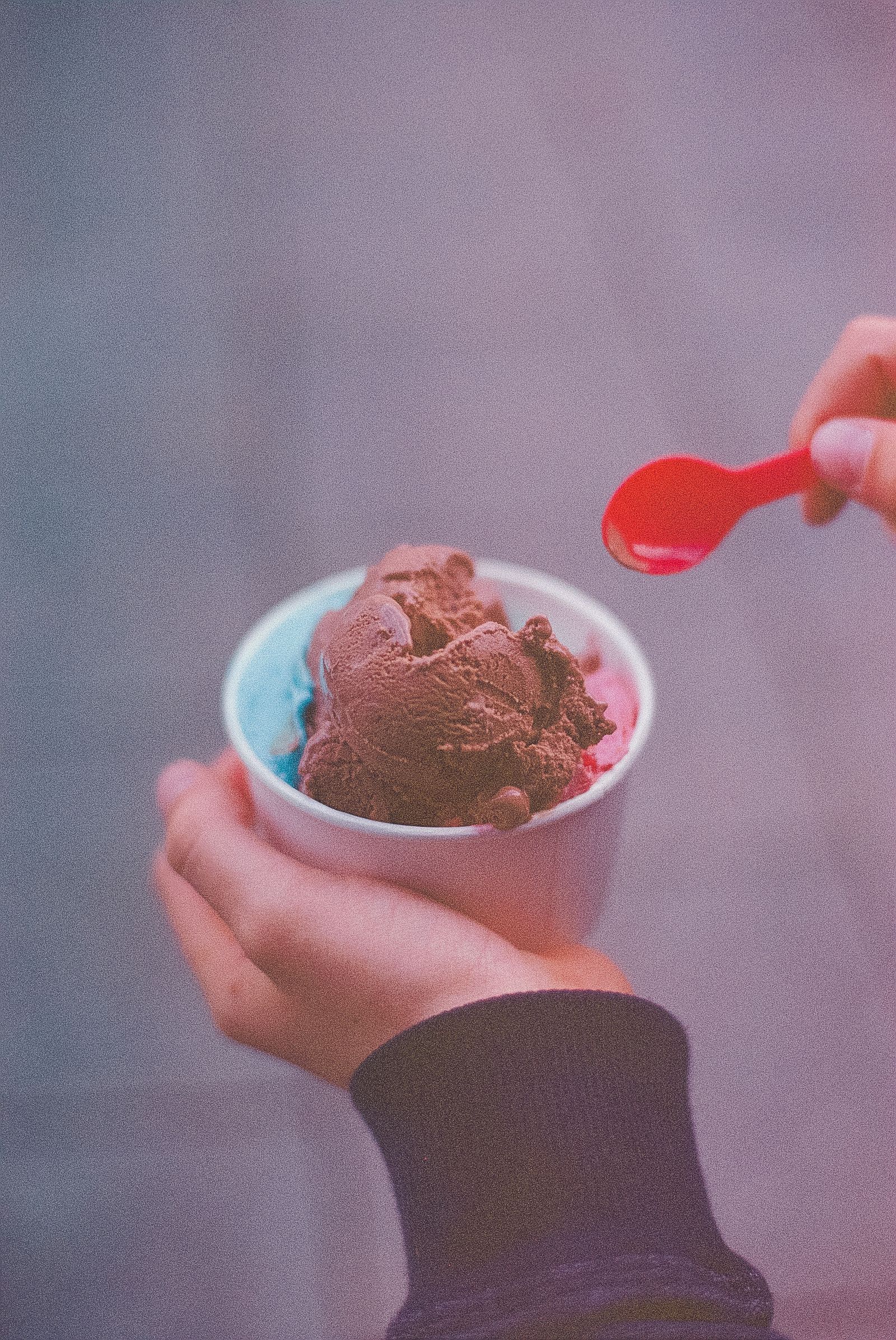
At retail, choose a solid product in an intact, dry package and report soft or leaking units. Image: Helena Lopes / Pexels.
Choose the correct action
When should you discard, return or keep ice cream?
If the evidence points in different directions, use the strongest item. A future date cannot rescue a leaking package. A smooth texture cannot override an overnight outage. A few crystals cannot prove contamination when a sealed tub remained at 0°F (-18°C).
Power-outage rule
What should you do with ice cream after a power outage?
Use the ice-cream-specific line in the federal chart rather than generic advice for another frozen food. FoodSafety.gov lists ice cream and frozen yogurt as discard items when ice crystals remain and the product feels refrigerator-cold, and also after exposure above 40°F (4°C) for more than two hours.
That conservative instruction differs from the chart’s handling of many meats, breads, fruits and other frozen products. Do not turn softened ice cream into a milkshake, bake it into another food or refreeze it and assume the history disappeared. Never taste it to decide.
Before and during an outage
- Keep the freezer at 0°F (-18°C) and use an appliance thermometer.
- Keep the door closed. A full freezer can hold temperature for about 48 hours; a half-full freezer for about 24 hours when unopened.
- Record the event time and follow local emergency information.
- Evaluate each product category separately after power returns.
Dates and recalls
Does ice cream expire after its best-by date?
A “Best if Used By” or best-by date is generally a quality signal in the United States, not a complete safety history. FDA and USDA recommend “Best if Used By” as a quality-based phrase indicating that flavor or performance may decline after the date. Ice cream can become icier, drier or less flavorful over time even while continuously frozen.
The date cannot tell you whether the tub melted in transit, leaked in a store or was exposed during an outage. A future date does not clear a damaged product, and a past quality date does not automatically make an intact, continuously frozen product dangerous. Follow the wording and storage instructions on the actual package.
Recall status must be checked separately because the issue may be invisible. FDA recall notices can identify a product through its name, flavor, package size, UPC, lot code, sell-by or use-by date, packaging images and distribution area. Match every available identifier; do not rely on the brand name alone.
Prevent quality decline
How should ice cream be stored at home?
Good storage slows crystal growth, freezer burn, oxidation and odor absorption. It cannot repair ice cream that already melted or restore a compromised package.
Avoid declaring one universal “opened ice cream lasts X months” rule. Formulation, package design, freezer stability, opening behavior and manufacturer instructions all change quality life. The decision method remains the same: history, integrity, recall status and then quality.

Homemade ice cream adds an ingredient-safety question that storage appearance cannot answer. Image: Katerina Holmes / Pexels.
Hausgemachtes Eis
Can homemade ice cream look good and still be unsafe?
Yes. A firm, smooth homemade batch can have an upstream ingredient or preparation risk that the freezer does not solve. Recipes using raw or undercooked eggs, or unpasteurized dairy, require separate attention. Freezing is not a substitute for pasteurization or adequate cooking.
FDA advises using pasteurized shell eggs or pasteurized egg products in recipes such as homemade ice cream when the eggs will be raw or undercooked when served. Other options are a properly cooked egg base or an egg-free recipe. Keep ingredients refrigerated, work with clean hands and equipment, cool cooked bases promptly and follow a reliable recipe.
Two separate questions: “Was the recipe prepared safely?” and “Was the finished dessert kept safely frozen?” A good answer to one does not automatically answer the other.
Retail and foodservice controls
Why are visual checks not enough for businesses?
A soft display case, frozen drips, stained cartons or a cluster of complaints can reveal a problem. They should trigger isolation and investigation, not replace temperature monitoring, receiving records, traceability or formal disposition. A clean-looking carton cannot prove that delivery and storage stayed within specification.
This consumer guide is not a HACCP plan, shelf-life protocol or release specification. Businesses should follow their quality system, supplier requirements, local regulation and product-specific emergency procedures.

Packaging and product quality
What can ice cream packaging actually protect?
Packaging cannot replace refrigeration, but it affects containment, closure integrity, air and moisture exchange, tamper evidence, decoration and traceability. These functions help a brand preserve intended quality and make abnormal handling easier to identify.
The specification should be validated with the real recipe, fill temperature, hardening route, storage range, case and pallet pattern, transport stresses, retail environment and consumer opening behavior. A room-temperature lid fit is not enough evidence for frozen use.
Closure and air control
A consistent reclose can limit dehydration, odor pickup and contamination after opening.
Manipulationsnachweis
A visible feature helps shoppers recognize whether the original closure condition changed.
Frozen handling
Filled packs should be assessed after conditioning, impact, stacking and the intended distribution sequence.
Rückverfolgbarkeit
Readable date, lot, barcode and supplier information supports complaints and recall matching.
Explore Honokage’s ice cream container range, testing overview and guide to tamper-evident ice cream containers. These are starting points; final performance and compliance require project-specific confirmation.
What should a packaging brief include?
- Fill volume, recipe category and product density
- Filling temperature, hardening process and storage range
- Lid, membrane, tamper-evident and reclose concept
- Low-temperature drop, stacking and transport conditions
- Artwork, date code, UPC and lot traceability
- Destination-market and food-contact requirements
- Sample plan, acceptance criteria and change control

Supplier testing information should be translated into project-specific methods, sample sizes and acceptance criteria.
Common mistakes
Five myths about spoiled ice cream
Frequently asked questions
Ice cream spoilage and storage FAQ
Can ice cream go bad in the freezer?
Yes, but “bad” can mean lower quality, a handling failure or a recall. Continuously frozen ice cream may lose flavor and texture over time. Melting, package damage, mold or a recall is a stronger concern.
Are ice crystals a sign that ice cream is spoiled?
They show recrystallization or storage change, not microbial spoilage by themselves. Use temperature history, package integrity and recall status before deciding whether the issue is only quality.
Is freezer-burned ice cream safe to eat?
Freezer burn is generally a quality defect caused by moisture loss and air exposure. It may taste dry or stale. Do not use it to clear a product that also melted, leaked, grew mold or matches a recall.
Can I smell or taste ice cream to test it?
No. A clearly wrong odor is a discard sign, but normal smell and taste do not prove safety. Do not sample suspect food after a power outage, package breach or recall.
What if there is mold on the ice cream?
Discard the entire tub. Do not scrape off the visible area, stir it into the product or taste the surrounding ice cream.
Can melted ice cream be refrozen?
Do not use refreezing to clear melted or softened ice cream. It cannot restore the original structure or reverse any warm-period microbial activity. When the history is uncertain, discard it.
Is ice cream past its best-by date unsafe?
Not automatically. “Best if Used By” is generally quality-based. Check the product’s storage history, package, recall status and manufacturer instructions rather than using the date alone.
Should I buy a soft carton from a store freezer?
No. Choose a solid product in a dry, intact package and tell store staff about the soft unit so they can inspect the case and affected inventory.
What should I do if my ice cream is recalled?
Match the brand, flavor, size, UPC, lot, date and distribution details in the official notice. If it matches, do not eat it. Follow the stated return or disposal instructions.
Plan a freezer-ready pack
Discuss an ice cream container around real closure, handling and traceability needs
Share the fill volume, product type, filling and hardening process, lid and tamper-evident concept, storage route, distribution tests, artwork, destination market and forecast volume. Honokage can use those inputs to discuss an existing format or custom project; final performance and compliance should be confirmed for the selected construction and intended use.
Final decision
Use the strongest evidence, not the most dramatic crystal
To determine whether ice cream has gone bad, start with what happened to it. A known thaw, outage, leaking package, broken closure, visible mold or matching recall gives a clear reason to discard or return the product. Do not ask a smell or spoonful to override that evidence.
If the tub remained continuously frozen at 0°F (-18°C), stayed intact and is not recalled, crystals, freezer burn or a past quality date may simply mean that the texture and flavor have declined. That distinction reduces unnecessary fear without taking an unknown cold-chain event lightly.
Sources and further reading
- FDA: Are You Storing Food Safely? — 0°F freezer guidance, freezing and bacteria, appliance thermometers and the freezer-burn quality boundary.
- FoodSafety.gov: Food Safety During Power Outage — ice-cream-specific discard guidance and the instruction never to taste food to determine safety.
- FDA: Surplus, Salvaged, and Donated Foods — package tears, leakage, stains, resealing and melt-refreeze shopping signals.
- USDA FSIS: Freezing and Food Safety — microbial dormancy, rapid freezing, refreezing and power-outage context.
- FDA and USDA: Food Date Labeling — “Best if Used By” as a quality-based phrase.
- FDA: Food Recalls—What You Need to Know — recall reasons, product identifiers and consumer response.
- FDA: Enjoying Homemade Ice Cream Without the Risk of Salmonella Infection — pasteurized egg and cooked-base options.
- Journal of Food Engineering: Temperature variation and ice cream recrystallization — research connecting frozen temperature variation with crystal growth and quality deterioration.
Editorial note: this article is general U.S.-oriented information, not a microbiological test, medical diagnosis, recall notice or product-release procedure. Follow local authorities, the manufacturer and qualified food-safety professionals when their instructions are more specific. If illness is suspected, seek appropriate medical guidance.